

When Your Garage Door Won’t Budge: Understanding Broken Torsion Springs
Broken torsion spring repair is the most common emergency garage door service call we receive at The Right Garage Door Dallas. If you’re reading this, chances are you just heard a loud bang from your garage, or your door suddenly refuses to open.
Quick Answer: What to Do Right Now
- Stop using the door immediately – Don’t try to force it open or use the opener
- Unplug your garage door opener – This prevents motor damage
- Keep everyone away from the door – Broken springs store dangerous energy
- Call a professional technician – This is not a DIY repair (seriously, we’ll explain why below)
- Expect same-day service – Most broken spring repairs take about an hour
You’re pulling up to the house after a long day and hit the garage door opener. Nothing happens. You try it again. Nothing. Your garage door has a broken spring, and it’s not just an inconvenience—it’s a safety issue.
Here’s the reality: That spring above your garage door does the heavy lifting for a door that weighs between 130 and 400 pounds. When it breaks, your door becomes a dangerous, immovable object. The spring is under extreme tension, storing enough energy to cause serious injury if handled incorrectly.
Most garage door torsion springs are designed to last about 10,000 cycles—roughly 7 to 10 years of normal use. When they fail, they fail dramatically. Many homeowners describe the sound as similar to a gunshot or firecracker.
The good news? A professional technician can replace your broken spring in about an hour. The bad news? This is absolutely not a job for DIY enthusiasts, no matter how handy you are around the house.
First Signs of Trouble: How to Know Your Torsion Spring is Broken
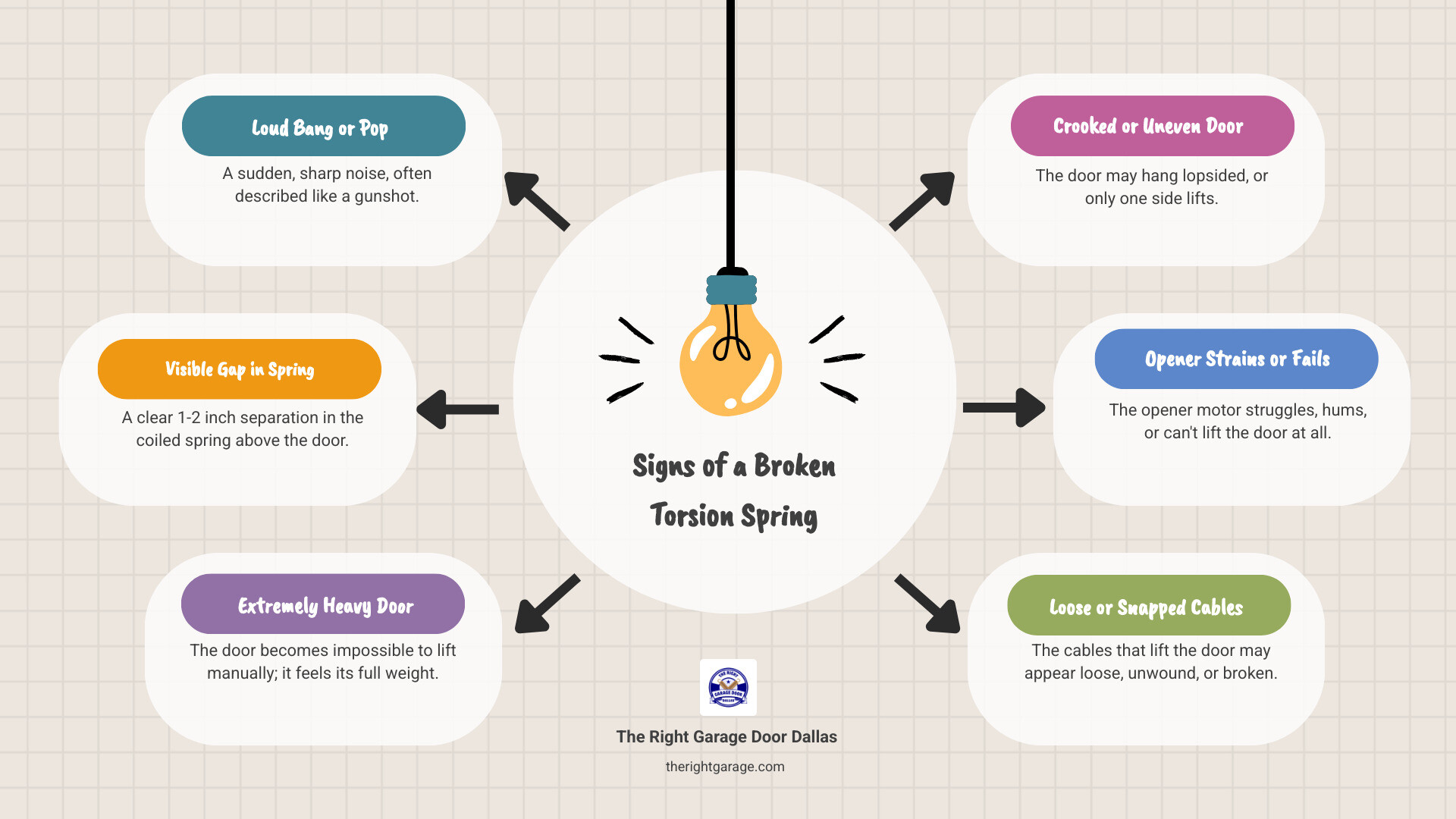
When a torsion spring breaks, it’s rarely subtle. The most common sign is a loud “POP!” or “bang” from your garage, like a firecracker. This is the sound of metal failing under extreme pressure.
Beyond the noise, here are other key signs your spring is broken:
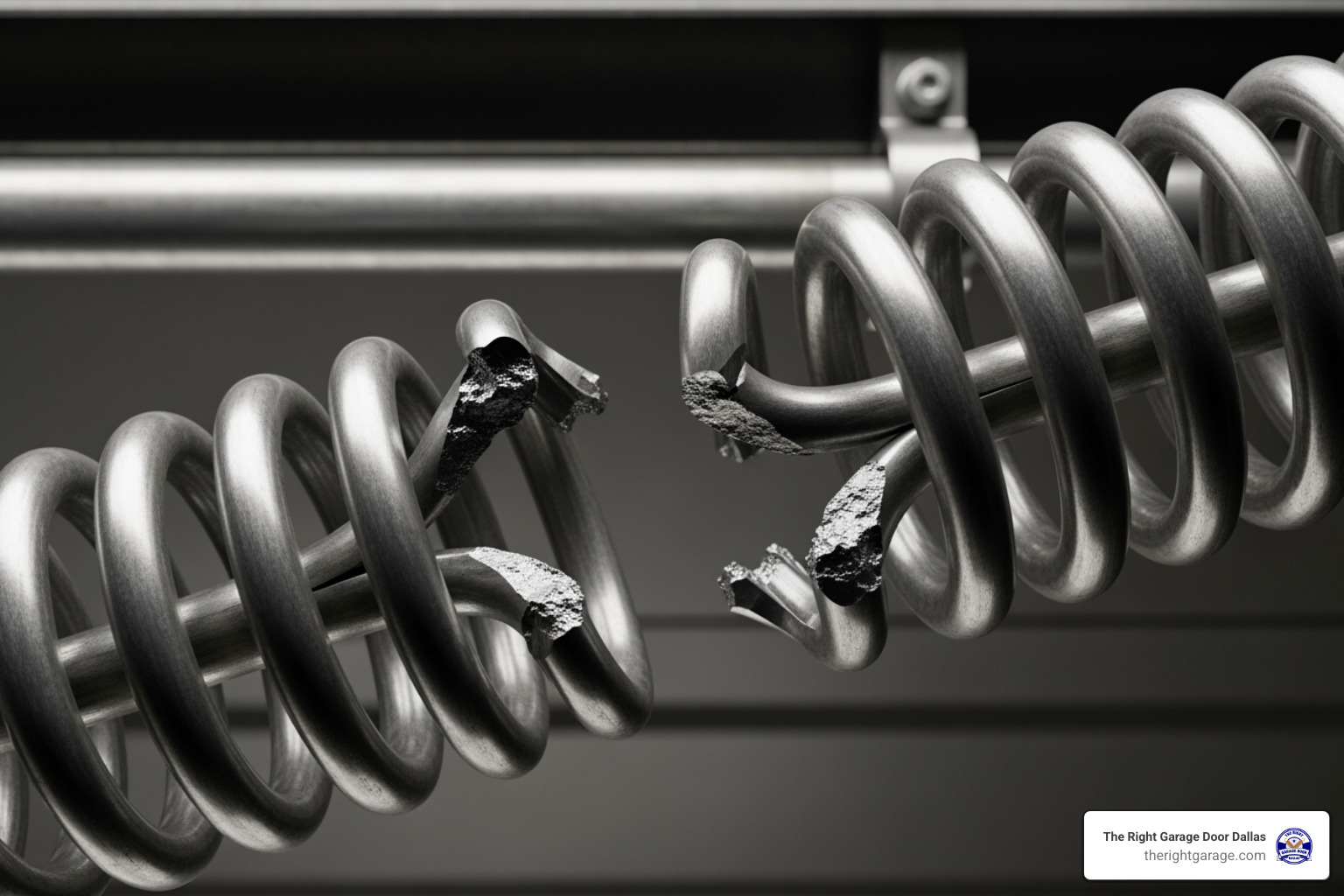
- Visible Gap in the Spring: A clear, two-inch gap in the tightly wound coil above your door is a definitive sign of a break.
- Crooked or Uneven Door: The door may hang unevenly or look crooked as it tries to move, especially if only one of two springs has broken.
- Door Slams Shut Forcefully: Without the spring’s counterbalancing force, the door becomes extremely heavy and may slam shut with dangerous speed.
- Door is Extremely Heavy: If you try to lift the door manually (with extreme caution), it will feel incredibly heavy, weighing anywhere from 130 to 400 pounds.
- Opener Strains or Fails: The opener motor will strain, make odd noises, or fail to move the door at all, as it’s not designed to lift the door’s full weight.
- Loose or Snapped Cables: The lifting cables connected to the spring system may become loose, tangled, or even snap when the spring breaks.
If you notice these signs, you likely have a broken torsion spring. For more information about our comprehensive repair services, please visit our Services page.
What to Do Immediately When a Spring Breaks
Knowing what to do right after a spring breaks can prevent further damage and ensure safety.
- Unplug the Opener: This is the most crucial step. It prevents accidental operation, which could destroy the opener motor.
- Do Not Use the Door: Do not attempt to open or close the door, even manually. It is now incredibly heavy, unbalanced, and dangerous.
- Keep People and Pets Away: Ensure everyone, especially children and pets, stays clear of the unstable garage door.
- Assess Visually (from a safe distance): Look for the tell-tale two-inch gap in the spring above the door to confirm the break.
- Call for Professional Help: This is not a DIY job. Contact a professional like The Right Garage Door Dallas immediately for same-day emergency service.
Risks of Using an Opener with a Broken Spring
Trying to use your opener with a broken spring is a recipe for more expensive problems. Here’s why:
- Burned-Out Opener Motor: The motor will strain to lift the door’s full weight, leading to overheating and burnout. This turns a spring repair into a more expensive opener replacement.
- Stripped Gears: The excessive force can strip the opener’s internal gears, rendering it useless.
- Damaged Door Panels: An unbalanced door can crash down, bending or cracking panels and potentially requiring a full door replacement.
- Bent Tracks: The uneven movement can pull the door off its tracks or bend them, adding to the repair bill.
- Complete System Failure: In a worst-case scenario, the entire system can suffer catastrophic damage, leading to extensive and costly repairs.
A professional broken torsion spring repair is a far better investment than paying for a new opener or a new garage door.
Understanding Your Garage Door’s Muscle: Springs 101
Your garage door’s springs are the muscles that make a heavy door feel light. Without them, your opener couldn’t lift the door, which can weigh hundreds of pounds.
How Torsion Springs Work
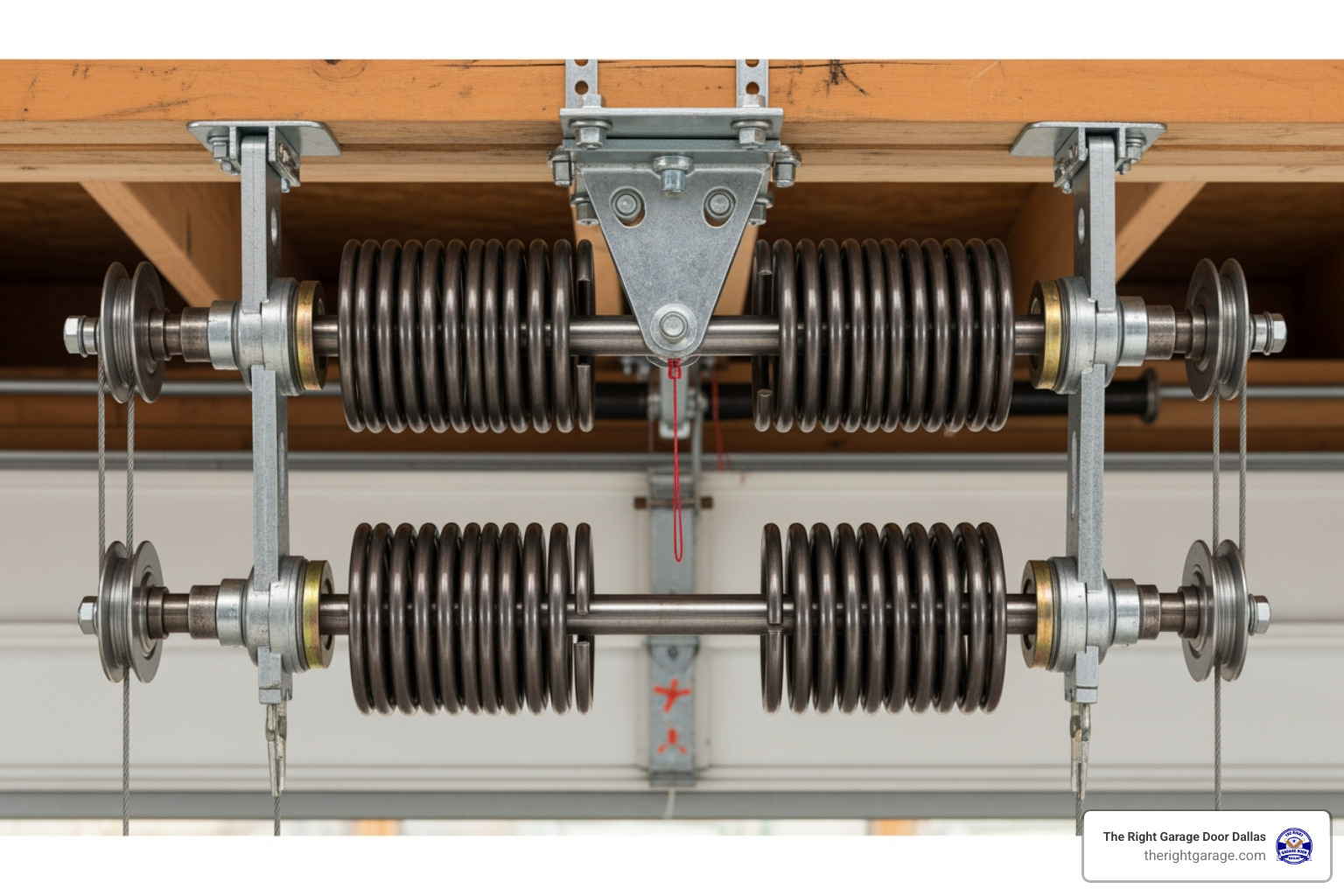
Located on a metal shaft above the garage door, torsion springs use torque (a twisting force) to counterbalance the door’s weight.
- Storing Energy: When the door is closed, the springs are tightly wound, storing rotational energy.
- Lifting the Door: As the door opens, the springs unwind, releasing that energy. This force is transferred through cables to lift the door, doing most of the heavy work.
- Making it Feel Light: Because the springs handle the weight, the door feels light enough to lift by hand and allows the opener to work with minimal effort. When the door closes, its weight rewinds the springs for the next cycle.
This system is an engineering marvel. You can learn more about the basics of Torsion Spring Design.
Torsion Springs vs. Extension Springs
While both spring types counterbalance a door, torsion springs are the modern standard for safety and performance. The Right Garage Door Dallas specializes in torsion spring systems.
Here’s a quick comparison:
| Feature | Torsion Springs | Extension Springs |
|---|---|---|
| Location | Mounted horizontally on a metal shaft directly above the door opening. | Mounted parallel to the horizontal tracks, running along the sides of the door. |
| Lifespan | Generally longer (10,000 to 20,000 cycles, or 7-10 years). | Generally shorter (5,000 to 10,000 cycles, or 4-7 years). |
| Safety | Considered safer; contained on a shaft, less likely to fly off if broken. | More dangerous; can snap and fly across the garage if safety cables aren’t installed or fail. |
| Cost | Typically more expensive to purchase and install. | Generally less expensive. |
| Performance | Smoother, quieter, and more balanced operation. | Can be noisier and provide less consistent balance over time. |
Why Do Torsion Springs Break?
Torsion springs are under constant stress and eventually fail. Here are the primary causes:
- Wear and Tear: This is the main culprit. Springs are rated for about 10,000 cycles (7-10 years of use). Each cycle causes metal fatigue, eventually leading to a break.
- Rust and Corrosion: Humidity, a factor in Dallas and Fort Worth, can cause rust. Rust weakens the metal and shortens the spring’s lifespan.
- Cold Weather: Metal becomes more brittle in cold temperatures, increasing the chance of a snap, especially on an older spring.
- Improper Installation or Maintenance: An incorrectly sized spring or poor maintenance can cause premature failure. Some builders cut costs by installing a single spring on a two-car door, which drastically reduces its lifespan.
Understanding these factors helps explain why broken torsion spring repair is such a common need for homeowners.
The Dangers of DIY: Why This is a Job for the Pros
While you may be a skilled DIYer, broken torsion spring repair is one job that must be left to trained professionals. The reason is simple: extreme danger.
Torsion springs are wound under immense tension to lift hundreds of pounds. If handled incorrectly, this stored energy can release explosively, causing life-threatening injuries.
The realities of a failed DIY repair include:
- Severe Injury: Incorrect handling can release explosive energy, causing lacerations, broken bones, head injuries, or worse. Winding bars, springs, or the door can become dangerous projectiles.
- Uncontrolled Energy Release: A torsion spring releases energy in a violent, uncontrolled snap if the proper tools and techniques are not used.
- Property Damage: An uncontrolled door can crash down, damaging your car, the door panels, or the tracks.
- Incorrect Tools and Experience: This repair requires specialized winding bars and a deep understanding of tension and mechanics. Using substitutes like screwdrivers is a recipe for disaster.
The risks of DIY repair far outweigh any potential savings. For your safety, please call a professional.
The Professional Guide to Broken Torsion Spring Repair
This section outlines the process our trained technicians follow. We emphasize again that attempting this without proper training and tools is extremely dangerous and not recommended for homeowners.
Tools and Safety Gear a Technician Uses
Our technicians arrive with a full set of professional tools and safety gear to perform the job safely and efficiently. This includes:
- Winding Bars: Specialized hardened steel rods for safely winding and unwinding springs.
- Socket Wrenches and Vise Grips: For securing components and the door itself.
- Safety Gear: Including a sturdy ladder, safety glasses, and heavy-duty gloves.
- Replacement Springs: The correct, high-quality springs for your specific door.
How to Correctly Measure for a Replacement Spring
Using the wrong spring can damage your door and opener. Our technicians take precise measurements to ensure the new springs perfectly match your door’s weight and size for a balanced, long-lasting repair. These measurements include:
- Wire Size
- Inside Diameter (ID)
- Spring Length
- Wind Direction (Left vs. Right)
This precision is key to a safe and effective repair. For more detailed insights into this process, you can refer to resources like How to Measure Garage Door Torsion Springs.
Step-by-Step Guide to Broken Torsion Spring Repair
Understanding the professional process highlights why expertise is crucial. Here’s a condensed overview of what our technicians do:
- Secure the Door: The technician first clamps the door to its track to prevent it from moving unexpectedly.
- Release Tension (Most Dangerous Step): Using special winding bars, the technician safely releases the immense tension from any unbroken springs.
- Remove Old Hardware: Once all tension is gone, the old, broken spring(s) and cables are carefully removed from the torsion shaft.
- Install New Springs: The new, correctly sized springs are installed. We always replace both springs on a two-spring system for safety and balanced operation.
- Thread Cables and Set Tension: New lifting cables are installed and properly aligned on the cable drums.
- Wind the New Springs (Dangerous Step): The technician uses winding bars to wind the new springs to the exact tension required to counterbalance your door’s weight.
- Lubricate and Test: All moving parts are lubricated, and the door is tested to ensure smooth, balanced operation.
A professional can typically complete this entire process in about an hour.
Final Check: Is the Door Balanced?
The final step is a balance test. This ensures the springs are doing their job correctly, which protects your opener from strain and extends the life of your system.
- Disconnect the Opener: The door is disconnected from the opener to test the springs alone.
- Lift Door Halfway: The technician lifts the door to waist height and lets go.
- Check for Movement: A perfectly balanced door will stay in place. If it rises, the springs are too tight. If it falls, they are too loose.
- Re-adjust Tension: The technician makes fine adjustments to the spring tension until the door is perfectly balanced.
This final check guarantees your door will operate smoothly and effortlessly.
Making the Call: Professional Repair and What to Expect
A broken garage door spring is a safety hazard requiring immediate, professional attention. The Right Garage Door Dallas offers fast and reliable broken torsion spring repair across Dallas, Fort Worth, Plano, Frisco, and all of North Texas.
When you choose us, you can expect:
- Same-Day Service: We offer fast, same-day service to get your door working again quickly.
- Licensed Technicians: Our technicians are highly trained, experienced, and licensed for safe, expert repairs.
- Warranty on Parts and Labor: We stand behind our work with a full warranty.
- Upfront Pricing: We provide clear, upfront pricing with no surprises.
Don’t let a broken spring compromise your safety. Get a Free Quote today!
When to Call a Professional Immediately
Procrastinating on a broken spring is dangerous. Call a professional immediately if:
- You hear a loud bang from the garage.
- You see a visible gap in the spring coil.
- The door is crooked, off-track, or won’t open.
- You are not trained in spring repair—this is not a DIY task.
A professional can safely complete the repair in about an hour.
The Cost of Professional Broken Torsion Spring Repair
Homeowners in the Dallas-Fort Worth area can typically expect professional broken torsion spring repair to cost between $200 and $400. This price includes new springs and labor.
Factors that influence the final cost include:
- Spring Type and Size: Larger, heavier doors require more robust and expensive springs.
- Double Spring Replacement: We always recommend replacing both springs on a two-spring system to ensure balance and prevent a second service call.
- Labor Costs: Our pricing covers the technician’s expertise and the dangerous nature of the job.
- Additional Repairs: If the broken spring caused other damage, those repairs will be quoted upfront.
This cost covers a specialized repair performed by a trained professional, ensuring your safety and the proper function of your garage door.
Frequently Asked Questions about Broken Torsion Spring Repair
Can I temporarily fix a broken torsion spring?
No. Attempting a temporary fix with clamps or welding is extremely dangerous. These methods are unreliable and can fail without warning, releasing explosive force and causing severe injury. The only safe solution for a broken torsion spring repair is a professional replacement.
Should I replace both springs if only one is broken?
Yes. If your door has two springs, we always recommend replacing both at the same time. Here’s why:
- Equal Lifespan: Both springs have the same amount of wear. If one broke, the other is likely to break soon.
- Balanced Door: Two new springs ensure the door is properly balanced, preventing strain on your opener and the new spring.
- Cost-Effective: Replacing both at once saves you money on a second service call in the near future.
Can cold weather cause my garage door spring to break?
Yes, cold weather can contribute to a spring breaking. The cold makes the metal more brittle and susceptible to snapping, especially if the spring is old and already fatigued. We often see an increase in broken torsion spring repair calls during colder months in the Dallas-Fort Worth area.
Conclusion
When it comes to your garage door, safety is paramount. A broken torsion spring repair is not a task to be taken lightly or attempted as a DIY project. The extreme tension stored within these springs makes them incredibly dangerous if handled without the proper training, tools, and expertise. The risks of severe injury, property damage, and even death far outweigh any potential savings from a DIY attempt.
Trusting a professional ensures your safety, the proper function of your garage door, and the longevity of your entire system. At The Right Garage Door Dallas, we pride ourselves on providing expert, safe, and efficient broken torsion spring repair services across Dallas, Fort Worth, Plano, Frisco, and all our North Texas service areas. Our licensed technicians are ready to assist you with same-day service, transparent pricing, and a commitment to your satisfaction.
Don’t get sprung by a DIY disaster. Schedule your professional repair service today and let us get your garage door operating safely and smoothly once again.


