

That Sudden SNAP! What’s Next for Your Wallet?
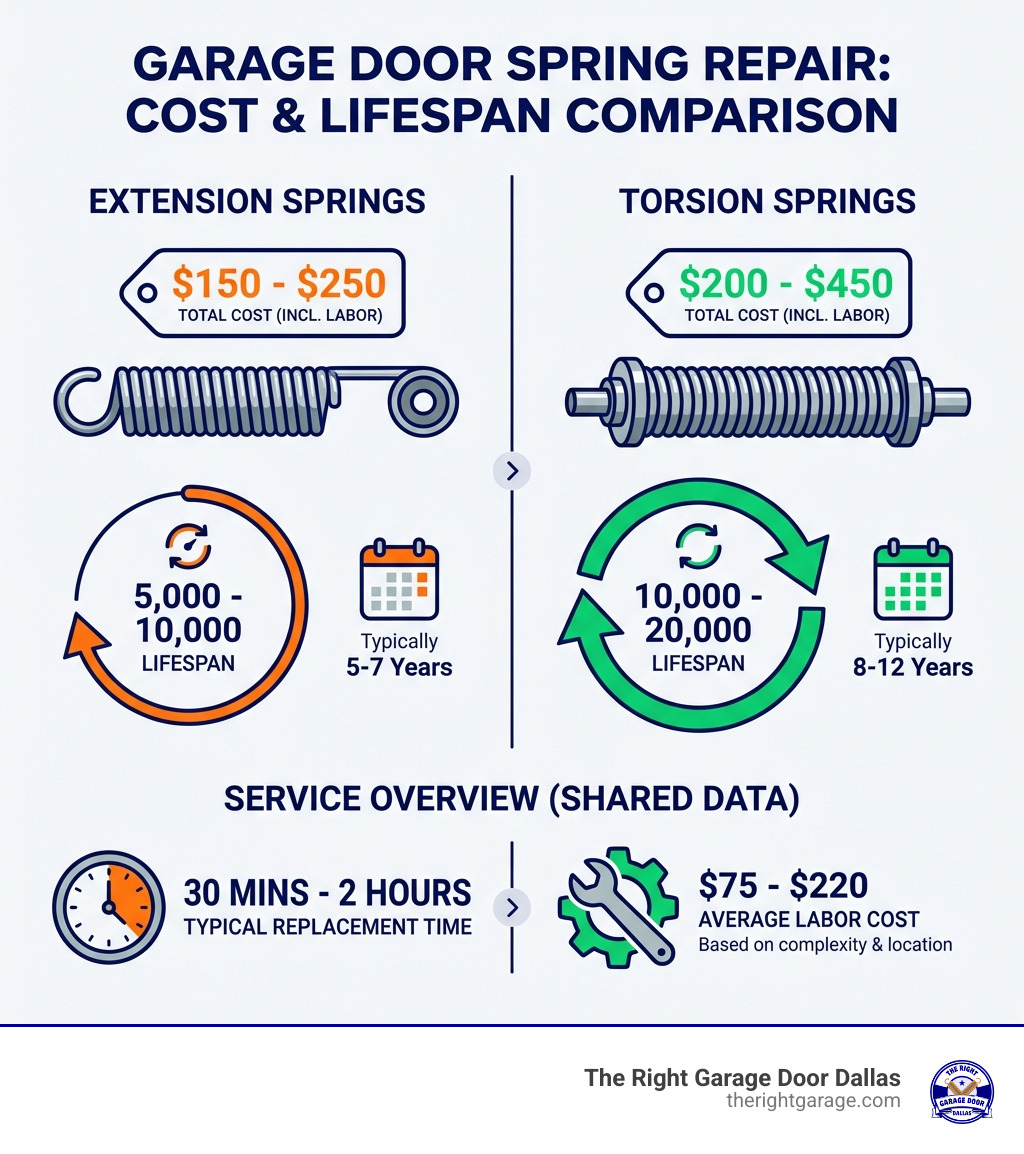
The cost for replacing garage door springs typically ranges from $150 to $450 in 2026, depending on the type of springs, your door size, and labor rates in your area. Here’s what you need to know right away:
Quick Cost Breakdown:
- Extension Springs: $150-$250 (including labor)
- Torsion Springs: $200-$450 (including labor)
- Labor Only: $75-$220
- Typical Replacement Time: 30 minutes to 2 hours
Most days, your garage door is just there—opening smoothly when you press the button, closing securely behind you. Then one morning, you hear a loud SNAP! like a firecracker going off. Your door won’t budge, or worse, it crashes down instead of lowering gently.
You’ve just experienced a broken garage door spring. It’s one of the most common garage door failures, and it happens without warning.
Here’s what matters right now: Garage door springs are under hundreds of pounds of tension. They’re the muscle that lifts your heavy door. When they break, your door becomes unsafe to operate. Don’t try to force it open or closed—you could damage the opener or hurt yourself.
The good news? Spring replacement is a routine repair for professionals. The better news? It’s usually more affordable than homeowners expect, especially when you know what factors affect the price.
Whether you’re dealing with a broken spring emergency or planning ahead, understanding the real costs helps you make smart decisions and avoid getting overcharged. Let’s break down exactly what you should expect to pay in the Dallas-Fort Worth area.
Understanding the Average Cost for Replacing Garage Door Springs
When that dreaded spring breaks, your first thought is often, “How much is this going to set me back?” We understand. The national average cost for replacing garage door springs generally falls between $150 and $450. However, in the Dallas-Fort Worth area, you’ll find these costs are quite consistent with the national averages, with most homeowners paying between $150 and $350 for a professional spring replacement, including parts and labor. Some situations, especially those involving specialized springs or multiple door systems, can see costs climb higher, sometimes over $500.
Why such a range? Well, your final bill is a bit like a recipe with several ingredients. Factors like the specific type of spring your door uses, the weight and design of your garage door, and local labor rates all play a role. Sometimes, a service call fee of $50-$100 might be applied, though many reputable companies, including ours, often waive this fee if you proceed with the repair. We aim for transparent, upfront pricing so you know exactly what to expect before any work begins.
Breaking Down the Cost for Replacing Garage Door Springs: Parts vs. Labor
To truly understand the total cost for replacing garage door springs, it helps to look at the two main components: the parts themselves and the labor to install them.
Let’s start with the parts. For extension springs, you might pay around $12-$50 per spring for the material if you were buying them yourself, but for professional replacement, the spring cost is baked into the overall service. Torsion springs are a bit heftier, both in price and design, with material costs ranging from $108-$150 each.
Then there’s the labor. This is where expertise comes in. Labor costs for garage door spring replacement typically range from $75 to $150. In the DFW metroplex, hourly rates for a skilled technician can be anywhere from $65 to $85. The good news is that replacing two springs on a garage door is a surprisingly quick job for a professional—it usually takes only 30 minutes to an hour. Even with more complex issues, a spring replacement typically takes no more than 1-2 hours.
Now, about replacing one spring versus two: almost every garage door uses two springs, and they work as a team. When one spring breaks, its partner has endured the exact same amount of wear and tear and is usually not far behind. Replacing just one creates an imbalance in your garage door system, putting undue stress on the new spring and other components. This can lead to premature failure of the new spring, or worse, damage to your garage door opener or tracks, resulting in more costly repairs down the line. That’s why we, and most professionals, strongly recommend replacing both springs at the same time. It ensures balanced operation, extends the lifespan of your entire system, and is more cost-effective in the long run.
For example, replacing a single torsion spring might cost between $200-$300 (including parts and labor), but replacing a pair jumps to $400-$500. Similarly, a single extension spring could be $200-$250, while a pair would be $350-$450. It’s an investment in the longevity and safety of your garage door.
Torsion vs. Extension Springs: A Major Cost Factor
The type of spring your garage door uses is one of the biggest factors influencing the cost for replacing garage door springs. There are two main types: torsion springs and extension springs.
| Feature | Torsion Springs | Extension Springs |
|---|---|---|
| Cost (Installed) | $200 – $450 per spring | $150 – $250 per spring |
| Lifespan (Cycles) | 10,000 – 30,000 cycles (8-15 years) | 5,000 – 10,000 cycles (7-12 years) |
| Safety | Mounted on a shaft above the door, less likely to fly off if broken. | Mounted on sides, require safety cables to prevent whipping if broken. |
| Common Door Type | Roll-up (sectional) garage doors, heavier doors | Single-panel tilt-up garage doors, lighter doors |
Let’s dive a little deeper:
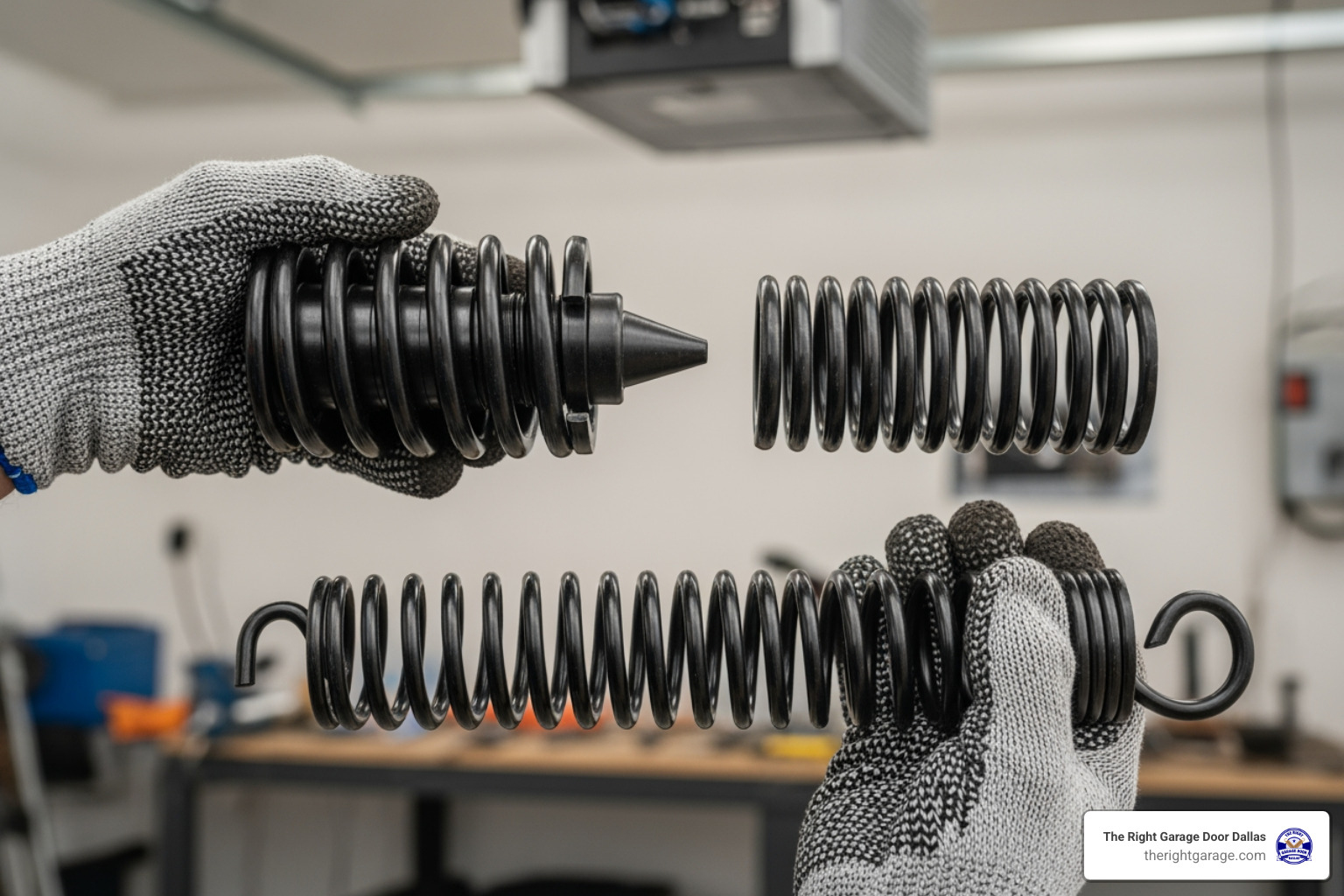
- Torsion Springs: These are typically mounted horizontally on a metal shaft directly above the garage door opening. They work by twisting (or “torquing”) to counterbalance the door’s weight. Torsion springs are known for their durability and smoother, quieter operation because they distribute the door’s weight more evenly. They generally have a longer lifespan, rated for 10,000 to 30,000 cycles (a cycle is one opening and closing of the door), which translates to about 8 to 15 years of daily use. Because they’re more robust and often used on heavier, larger doors, the cost for replacing garage door springs of the torsion type is usually higher, averaging $200-$450 per spring installed.
- Extension Springs: These springs run parallel to the horizontal tracks on either side of your garage door. They work by stretching and contracting as the door moves. Extension springs tend to wear out faster, typically lasting 5,000 to 10,000 cycles (about 7 to 12 years). They are often found on lighter, single-panel tilt-up doors. While the springs themselves might be cheaper (around $50-$100 each for parts), the installed cost generally ranges from $150-$250 per spring. A crucial safety note for extension springs: they absolutely require safety cables threaded through them. These cables prevent the spring from whipping dangerously across your garage if it breaks, which can cause serious injury or property damage.
For homeowners, the key takeaway is that torsion springs are generally considered a superior choice due to their longevity and inherent safety, especially if you’re looking to upgrade or convert your system. Speaking of conversion, if your door currently uses extension springs and you want to switch to a torsion system, expect costs to be higher, typically between $400 and $800, as this involves more extensive changes to your garage door’s hardware.
How Your Garage Door Itself Affects Pricing
Beyond the spring type, your garage door’s characteristics play a significant role in determining the cost for replacing garage door springs. It makes sense, right? A heavier, more complex door needs different springs than a light, simple one.
- Door Weight: This is paramount. Heavier garage doors require larger, stronger, and often more expensive springs to counterbalance their weight effectively. For instance, a heavy wooden door will demand more powerful springs than a lightweight steel door. This can add an extra $5 to $10 per spring or set.
- Door Material: The material of your door directly impacts its weight.
- Steel Doors: Typically lighter, with spring replacement costs around $100-$300.
- Wood Doors: Heavier, requiring more robust springs, often pushing costs to $250-$800.
- Glass or Custom Doors: These can be quite heavy or have unique requirements, leading to costs upwards of $300.
- Insulated Doors: Add extra weight, often necessitating heavy-duty springs, with costs ranging from $250-$400.
- Door Size (Single vs. Double): A standard single-car garage door will obviously have lower spring replacement costs than a wider double-car garage door. Double doors usually require multiple, larger spring sets, increasing both parts and labor. Expect an extra $15-$30 per spring for double garage doors, bringing total costs for double-door spring replacement to $300-$600.
- Door Type:
- Roll-up (Sectional) Doors: These are the most common type and typically use torsion springs. Spring replacement costs generally range from $75-$150 per spring for parts, with installed costs being higher.
- Tilt-up (One-Piece) Doors: Often use extension springs, with parts costing $50-$100 per spring.
- High-Cycle Springs: If you use your garage door frequently (more than 5 times a day), you might consider investing in high-cycle springs. While they cost an additional $200-$300 upfront, these springs are designed to last 20,000 to 50,000 cycles (15-20+ years), offering significant long-term value and fewer replacements.
Why Professional Garage Door Spring Replacement is the Smart Choice
We’ve all seen those DIY videos online, making complex tasks look deceptively simple. But when it comes to garage door springs, we strongly advise against a DIY approach. These springs are under immense tension—hundreds of pounds of force—and if mishandled, they can cause severe injury, including broken bones, lacerations, or even death. This isn’t a task for the average homeowner, and here’s why professional garage door spring replacement is always the smart choice.
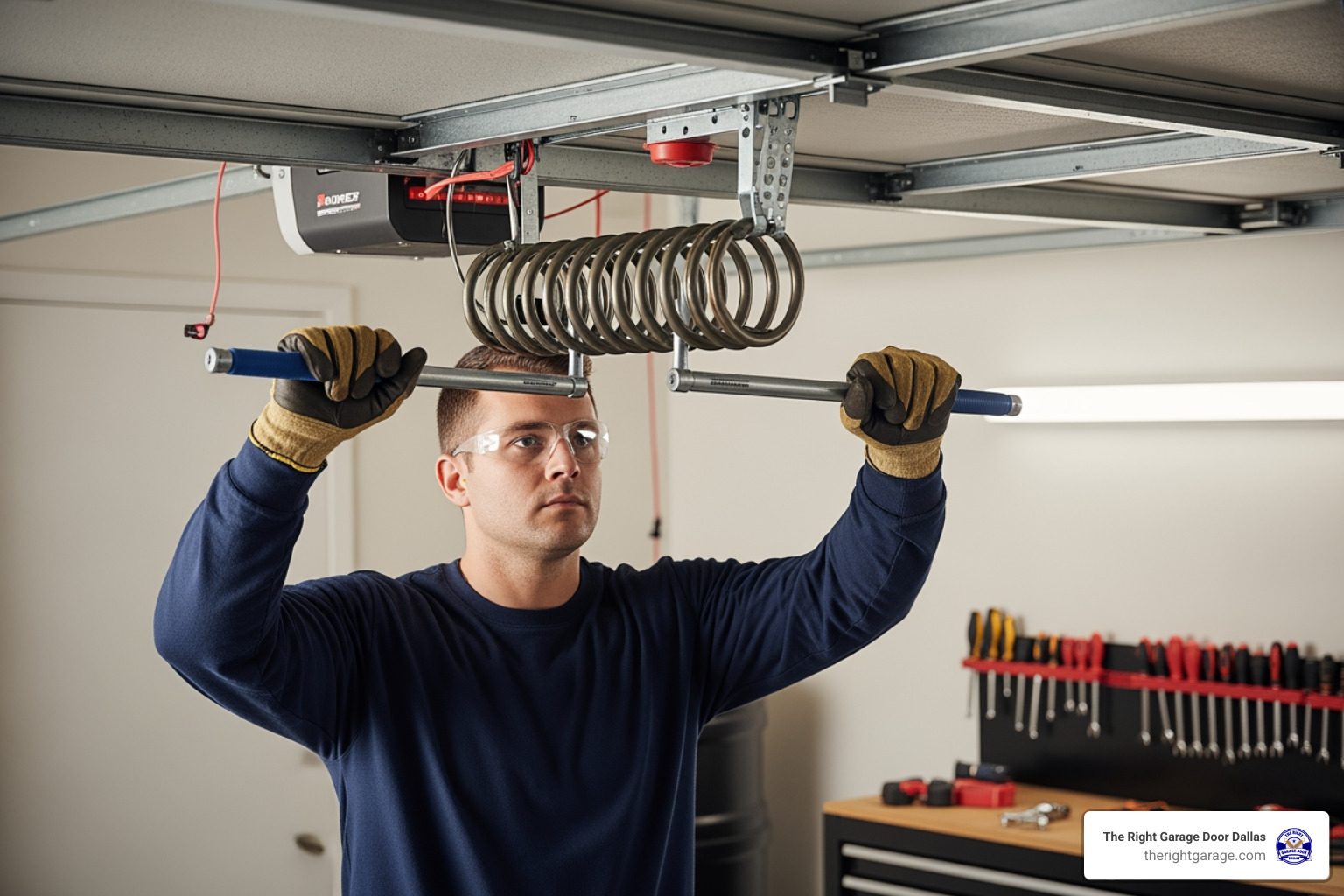
- Safety and Expertise: Our licensed technicians are trained specifically to handle garage door springs safely. We have the expertise to assess your specific door, identify the correct spring type and size, and perform the replacement with precision. We know the risks and how to mitigate them.
- Proper Tools and Techniques: Replacing springs requires specialized tools, such as winding bars for torsion springs, which are not typically found in a homeowner’s toolbox. We use professional-grade equipment and techniques to ensure the springs are installed and tensioned correctly.
- Warranty on Parts and Labor: When you choose a professional service like ours, you benefit from warranties on both the new springs and the labor. This provides peace of mind, knowing that your investment is protected. Manufacturer warranties on springs often cover replacements but typically not the labor, so having a service warranty is a significant advantage.
- Risks of Improper Installation: An improperly installed spring can create an imbalance that stresses other components of your garage door system, leading to premature wear and potentially more expensive repairs down the road. Worse, an incorrectly tensioned spring can still be a safety hazard.
- Value of Professional Service: Beyond safety, professionals ensure your door operates smoothly, quietly, and efficiently. We can spot other potential issues before they become major problems, offering a comprehensive service that DIY simply can’t match. We’re not just replacing a part; we’re restoring the safe and optimal function of your entire garage door system.
What to Expect from a Professional Garage Door Spring Replacement
When you call us for garage door spring replacement in the Dallas-Fort Worth area, here’s what you can expect from our professional team:
First and foremost, you’ll receive upfront pricing. We believe in transparency, so you’ll know the cost for replacing garage door springs before we even begin the work. There are no hidden fees or surprises.
Our service includes:
- Expert Diagnosis: Our technicians will accurately assess your garage door system, confirming the spring type, door weight, and identifying any other related issues.
- High-Quality Parts: We use durable, high-quality springs appropriate for your specific garage door.
- Safe and Efficient Installation: Using specialized tools and techniques, we’ll remove the old springs and install the new ones quickly and safely, typically within 30 minutes to 2 hours.
- Proper Tensioning and Balancing: This crucial step ensures your garage door operates smoothly, quietly, and stays balanced. We’ll fine-tune the springs for optimal performance.
- System Check: We’ll perform a comprehensive check of your entire garage door system, including cables, rollers, and opener, to ensure everything is in perfect working order.
- Cleanup: We’ll remove and dispose of the old springs responsibly.
- Peace of Mind: Knowing that experienced, licensed technicians have handled such a critical and dangerous repair brings invaluable peace of mind.
We pride ourselves on offering same-day service across Dallas, Fort Worth, Plano, Frisco, Richardson, Irving, Carrollton, Garland, Mesquite, Grand Prairie, and Addison. If your spring breaks, we’re here to get your garage door back in action quickly and safely, often with 24/7 emergency support available.
Is It Just the Springs? Recognizing Signs and Planning Your Repair
Often, a broken garage door spring announces itself with a dramatic “SNAP!” But sometimes, the signs are more subtle, slowly escalating into a full-blown problem. Recognizing these indicators early can help you plan your repair and potentially prevent further damage.
Here are the key signs that your garage door springs are failing or already broken:
- Loud Bang or Snap: This is the most unmistakable sign. It often sounds like a firecracker or gunshot, indicating a spring has broken under tension.
- Visible Spring Gap: If you have torsion springs, look above your door. A clear gap in one of the coiled springs means it’s broken. For extension springs, you might see a stretched-out, distorted spring or one hanging loosely.
- Crooked or Uneven Door: If your garage door looks like it’s trying to do the limbo, opening or closing unevenly, or hanging crookedly, it’s a strong sign of spring issues. An imbalance means one spring is working harder than the other, or one has failed entirely.
- Door Feels Heavy: Try opening your garage door manually (after disconnecting the opener, please!). If it feels incredibly heavy and difficult to lift, the springs aren’t doing their job.
- Opener Straining: Your garage door opener is designed to assist the springs, not lift the entire weight of the door. If you hear your opener motor straining, grinding, or struggling more than usual, it’s a cry for help from your springs.
- Door Slams Shut: A properly balanced garage door should descend smoothly. If it crashes down rapidly or won’t stay open halfway, the springs have lost their tension.
- Door Won’t Open Completely or Stays Closed: Without the springs’ assistance, your opener may not have enough power to lift the door, especially if it’s a heavy one.
- Loose or Broken Cables: Springs work in conjunction with cables. If you see frayed or broken cables, it often indicates a spring issue that has put excessive stress on the cable system.
- Excessive Noise (Squealing, Grinding): While some noise is normal, unusually loud squealing or grinding could mean your springs are dry, worn out, or improperly functioning.
Spring Repair vs. Full Door Replacement
When facing a broken garage door spring, the question often arises: should we just replace the springs, or is it time for an entirely new garage door? It’s a common dilemma, and the answer often comes down to the age and overall condition of your existing door.
When to Repair Springs: If your garage door is relatively new (less than 15 years old), and the only significant issue is the broken or worn-out springs, then a spring repair or replacement is almost always the most cost-effective solution. The average cost for replacing garage door springs is significantly less than a full door replacement, which can range from $750 to $2,000. If the panels are in good shape, the tracks are straight, and the opener is functioning well (aside from the spring issue), then focusing on the springs makes perfect sense.
When to Consider Full Door Replacement: However, if your garage door is showing its age—typically 15 years or older—or if you’re experiencing multiple failing components beyond just the springs, a full replacement might be the smarter long-term investment. Ask yourself:
- Is the door itself old and worn out? The average lifespan of a garage door is 15-30 years.
- Are there other significant issues? This could include damaged panels, bent or rusted tracks, a failing opener, or outdated safety features. If the combined cost of repairing all these elements approaches the price of a new door, it’s worth considering.
- Do you want to upgrade? Perhaps you’re looking for better insulation, improved security, or a refreshed aesthetic for your home.
While the upfront cost of a new garage door is higher ($956–$1,674 on average), it can offer better long-term value, improved energy efficiency, improved safety, and a boost to your home’s curb appeal. We can help you assess the condition of your entire system and provide an honest recommendation on the most cost-effective path forward.
Frequently Asked Questions about Garage Door Spring Replacement
We hear a lot of questions about garage door springs, and for good reason—they’re critical to your door’s function and safety! Here are some of the most common inquiries we receive:
How long do garage door springs last?
The lifespan of your garage door springs is measured in “cycles,” where one cycle equals one complete opening and closing of the door.
- Torsion springs are typically rated for 10,000 to 20,000 cycles, which usually translates to 8 to 15 years of normal use. Some high-quality torsion springs can even last up to 50,000 cycles.
- Extension springs generally have a shorter lifespan, rated for 5,000 to 10,000 cycles, or about 7 to 12 years.
Several factors affect how long your springs will last:
- Usage: The more you open and close your garage door (the more cycles it completes), the faster the springs will wear out. Most households use their garage door 3-5 times a day.
- Maintenance: Regular lubrication and inspections can significantly extend spring life by preventing rust and reducing friction.
- Climate: In the Dallas-Fort Worth area, varying temperatures and humidity can contribute to rust and corrosion if springs aren’t properly maintained.
- Quality: Investing in higher-quality, often high-cycle, springs can provide a longer lifespan and better long-term value.
Should I replace both garage door springs at the same time?
Yes, absolutely! This is one of our strongest recommendations. Here’s why:
- Paired Wear and Tear: Garage door springs work in tandem. If one spring has broken, the other has endured the exact same amount of work and stress throughout its life. It’s highly likely to fail soon after the first one.
- Maintaining Balance: Replacing only one spring creates an imbalance. The new spring will be stronger than the old, worn-out one, causing your door to operate unevenly. This puts undue strain on the new spring, the garage door opener, cables, and tracks, leading to premature wear and potentially more damage.
- Preventing Future Failure: Replacing both springs at once saves you from the inconvenience and potential emergency of another broken spring shortly down the line.
- Cost-Effectiveness: While the upfront cost for replacing both garage door springs is higher, it’s often more cost-effective than paying for two separate service calls and labor charges when the second spring inevitably breaks.
For safety and optimal performance, we always advise replacing springs in pairs.
How can I save money on garage door spring replacement?
While the cost for replacing garage door springs is a necessary expense, there are smart ways homeowners in the Dallas-Fort Worth area can save money without compromising safety or quality:
- Regular Maintenance is Key: An ounce of prevention is worth a pound of cure! Lubricating your springs and other moving parts with a silicone-based lubricant 2-3 times a year can significantly extend their lifespan and prevent rust. We also recommend annual professional tune-ups to catch minor issues before they become costly repairs.
- Get Multiple Quotes: Don’t settle for the first estimate. Contact 2-3 reputable local companies to compare quotes. Ensure the quotes are itemized and include parts, labor, and any service fees.
- Avoid Emergency Calls (When Possible): Emergency service typically comes with a higher fee (sometimes $165-$250 extra). If you notice signs of wear before a complete break, scheduling a repair during regular business hours can save you money.
- Invest in Quality, High-Cycle Springs: While they have a higher upfront cost (adding $200-$300), high-cycle springs last much longer. This means fewer replacements over the years, saving you money in the long run.
- Bundle Services: If you need other garage door repairs (e.g., cable replacement, roller upgrades), ask if you can bundle them with your spring replacement for a potential discount.
- DIY Preparation: If you’re hiring a professional, ensure the work area is clear of vehicles and clutter. This can sometimes reduce service time, which may translate to lower labor costs if they charge by the hour.
Get the Right Fix at the Right Price
Dealing with a broken garage door spring is never fun, but understanding the cost for replacing garage door springs and the factors influencing it can make the process much smoother. Average costs in the Dallas-Fort Worth area typically range from $150 to $450, depending on your spring type, door characteristics, and labor.
Above all, your safety and the safety of your family are paramount. Garage door springs are under extreme tension and should only be handled by trained professionals. Attempting a DIY repair can lead to serious injury and further damage to your garage door system.
At The Right Garage Door Dallas, we’re committed to providing expert, safe, and efficient garage door spring replacement services across the Dallas-Fort Worth area, including Plano, Frisco, Richardson, Irving, Carrollton, Garland, Mesquite, Grand Prairie, and Addison. We offer licensed technicians, transparent upfront pricing, and fast, same-day service, often with 24/7 emergency support. When you choose us, you’re choosing peace of mind and a garage door that operates smoothly and safely for years to come.
Don’t let a broken spring leave you feeling sprung!


