

Why Your Garage Door Won’t Close and What to Do About It
Garage door won’t close? You’re not alone. This frustrating problem affects thousands of Dallas-Fort Worth homeowners every day, often at the worst possible times—when you’re rushing to work, trying to secure your home for the night, or dealing with unpredictable Texas weather.
Quick Answer: The Most Common Reasons
- Misaligned or dirty safety sensors – The invisible beam near the ground is blocked or interrupted
- Track obstructions – Debris, tools, or bent tracks blocking the door’s path
- Dead remote batteries – Simple fix that’s often overlooked
- Limit switch problems – The opener thinks the door is already closed
- Broken springs or cables – Dangerous mechanical failure requiring professional help
According to industry data, misaligned or dirty sensors are the #1 cause of garage doors refusing to close. The good news? Many of these issues have simple fixes you can handle yourself in just a few minutes.
But here’s what matters most: A garage door that won’t close isn’t just an inconvenience—it’s a security vulnerability. It leaves your home exposed to theft, weather damage, and unwanted pests. Plus, forcing a malfunctioning door to close can cause expensive damage or even injury.
In this guide, we’ll walk you through exactly how to diagnose why your garage door won’t close and fix it safely. We’ll cover everything from the simple 30-second sensor check to knowing when it’s time to call in the pros.
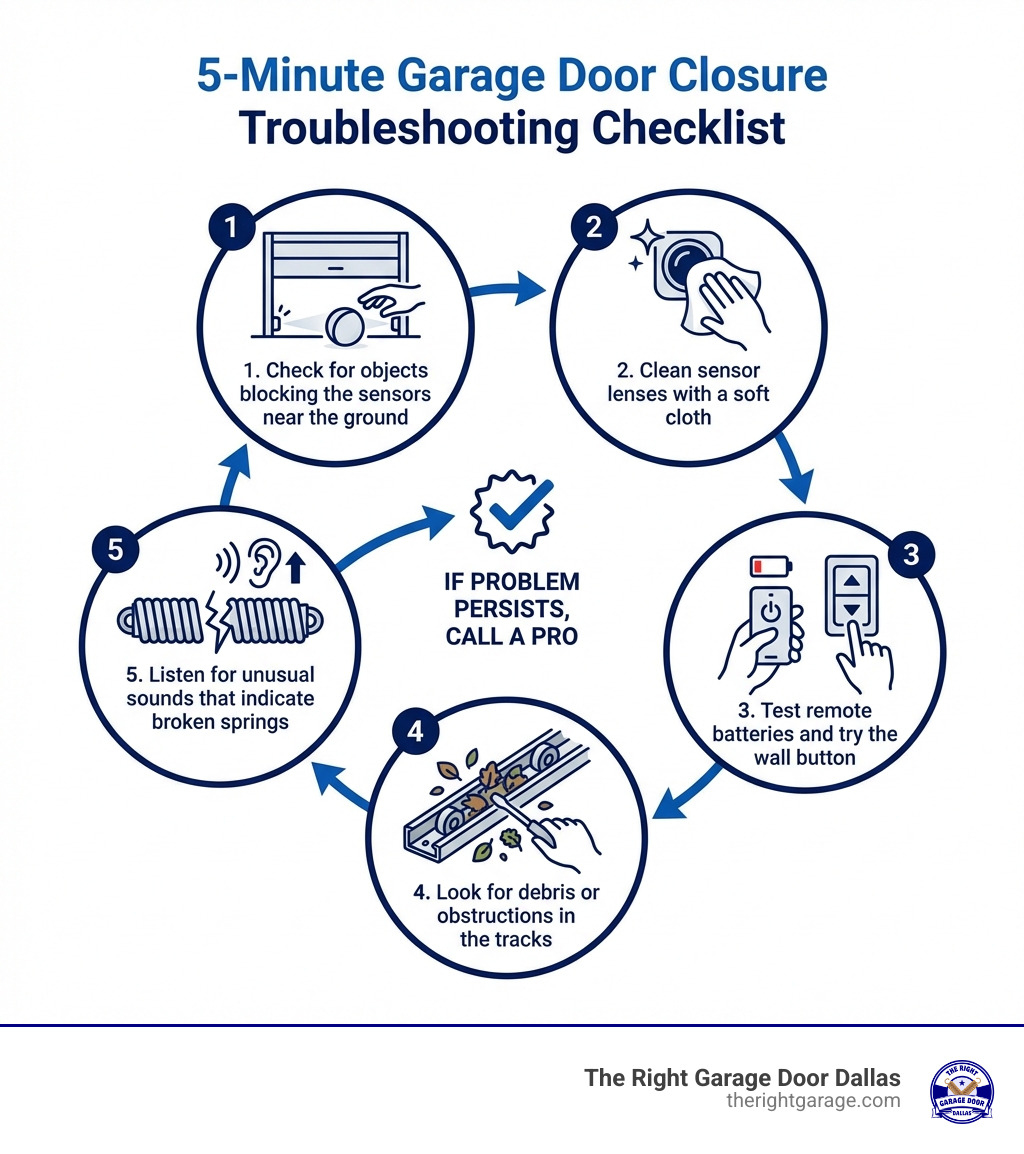
Garage door won’t close terms simplified:
Why Your Garage Door Won’t Close: Common Culprits
When your garage door won’t close, the culprit is usually one of a few usual suspects. At The Right Garage Door Dallas, we see these issues daily across North Texas. The system is designed with safety as the priority; if the “brain” of your opener (the logic board) senses anything is wrong, it will default to the open position to prevent crushing an object, a pet, or a person.
The most frequent issues include:
- Safety Sensor Malfunctions: These are the “eyes” of your door. If they are dirty, blocked, or knocked out of alignment, the door will refuse to shut.
- Track Obstructions: Even a small pebble, a stray toy, or a buildup of grime in the tracks can trigger the safety reversal.
- Remote and Power Issues: Sometimes the problem isn’t mechanical at all, but a simple lack of communication between your remote and the motor.
- Mechanical Wear: Worn-out rollers or loose hardware can create enough friction to make the opener think it has hit an obstacle.
If you’ve checked the basics and the door still won’t budge, you can learn more about sensor troubleshooting or explore our full range of repair services to get your home secure again.
Troubleshooting Why Your Garage Door Won’t Close
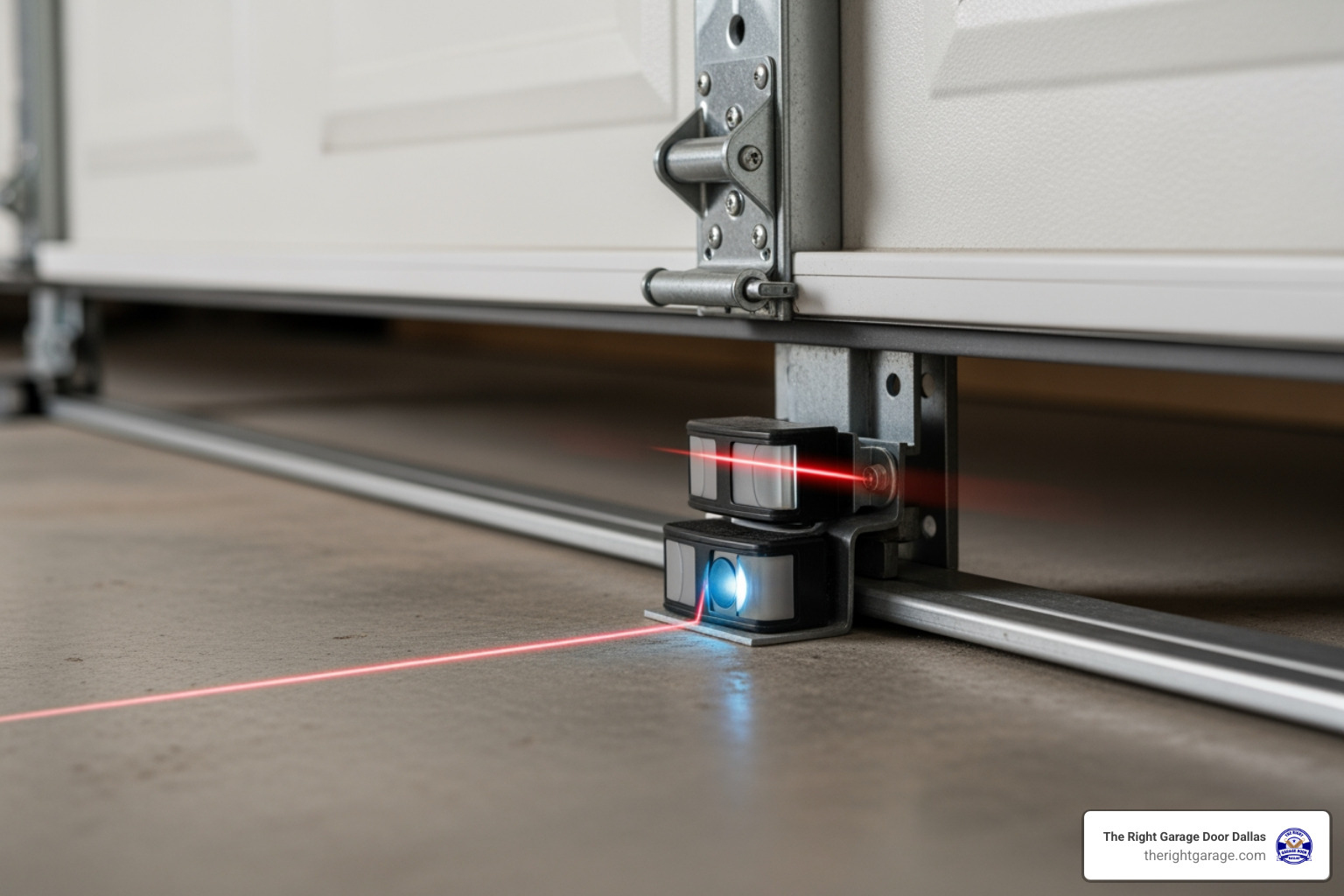
The safety sensors (photo eyes) are located about six inches above the garage floor on both sides of the door track. They send an invisible infrared beam across the opening. If that beam is broken, the garage door won’t close.
Step 1: The Cleaning
Dust, spiderwebs, and North Texas dirt can coat the lenses. Wipe both sensor lenses with a soft, dry cloth. Avoid using harsh chemicals that could cloud the plastic.
Step 2: Check the Alignment
Each sensor should have a small LED light. Usually, one is green and one is amber (yellow). If one is flickering or dark, they aren’t “seeing” each other. Loosen the wingnut on the bracket, adjust the sensor until the light stays solid, and tighten it back up.
Step 3: Sunlight Interference
Believe it or not, the bright Texas sun can actually “blind” your sensors. If your garage door won’t close only during certain times of the day when the sun hits the sensors directly, you might need to create a small “sun shield” out of cardboard or a toilet paper roll to shade the lens.
For a visual walkthrough, check out this video guide for sensor repair.
Inspecting Tracks and Rollers for Obstructions
If the sensors are fine but the door starts to close and then reverses, the problem is likely physical resistance. Your garage door tracks act as the highway for your door; if there’s a “roadblock,” the door stops.
- Clear the Path: Inspect the entire length of the tracks. We’ve found everything from broom handles to small rocks lodged in the tracks.
- Look for Bents: A slight bend in the metal track can cause the rollers to bind. You can sometimes gently tap these back into place with a rubber mallet, but severe damage requires professional track alignment.
- Lubrication is Key: Dry rollers and hinges create friction. Use a silicone-based garage door lubricant. Avoid WD-40 for long-term use, as it actually attracts dust and grime which can lead to more clogs later.
- Check Hardware: Over time, the vibrations of the door can loosen the bolts holding the tracks to the wall. Ensure everything is snug, but don’t overtighten.
Advanced Fixes for a Garage Door That Won’t Close
Sometimes the issue lies within the settings of the opener itself. As garage door openers age (they typically last 10 to 15 years), their internal settings can drift or the gears can wear down.
Adjusting Travel Limits and Force Settings
If your garage door won’t close all the way—perhaps it stops an inch above the floor or hits the floor and immediately pops back up—the “travel limits” are likely off. This tells the motor exactly how far to move the door.
On the back or side of your motor unit, you’ll find two screws or buttons labeled “Up” and “Down” or “Travel.”
- If the door reverses after hitting the floor: The “Down” limit is set too far. Turn the screw a quarter-turn in the direction indicated to decrease travel.
- If the door stops before touching the floor: The “Down” limit needs to be increased.
- Force Settings: There are also “Force” adjustments. These control how much “muscle” the motor uses. If these are too low, the door might stop because it thinks the natural weight of the door is an obstruction. Warning: Setting the force too high is dangerous as it can override safety features and crush objects.
Re-engaging the Emergency Release Trolley
Every garage door has a red emergency release cord. If someone pulled this, your door is in “manual mode.” The motor will run, the trolley will move back and forth, but the door stays still.
To re-engage the door:
- Pull the red cord toward the garage door (this usually resets the spring lever on the carriage).
- Manually lift the door until you hear a “click” or see the trolley lock into the opener carriage.
- Press your remote button; the trolley should now move the door.
DIY vs. Professional Repairs: When to Call the Experts
While we love empowering homeowners to handle simple maintenance, some parts of a garage door are under extreme tension and can be lethal.
| Issue | DIY Friendly? | Risk Level | Recommendation |
|---|---|---|---|
| Dirty/Misaligned Sensors | Yes | Low | Clean and realign manually |
| Dead Remote Batteries | Yes | Low | Replace with standard coin cells |
| Track Obstructions | Yes | Low | Remove debris and lubricate |
| Travel Limit Adjustment | Yes | Medium | Follow manual carefully |
| Broken Springs | No | High | Call The Right Garage Door Dallas |
| Frayed/Snapped Cables | No | High | Immediate professional repair |
| Logic Board Failure | No | Medium | Electrical expertise required |
Mechanical Failures and Safety Hazards
If you’ve checked the sensors and the tracks but the garage door won’t close, you may be facing a mechanical failure. These are the “heavy lifting” components of the system.
Identifying Dangerous Broken Springs or Cables
Garage door springs are the muscles of the door. They are rated for an industry standard of 10,000 cycles, which typically lasts about 7 years with 3-4 daily uses. When they break, it’s often with a loud “bang” that sounds like a gunshot.
- Torsion Springs: Located on a bar above the door. If you see a gap in the coils, the spring is broken.
- Extension Springs: Located along the side tracks. If they are hanging limp or have snapped, the door will not operate safely.
- The Danger: A door with a broken spring is essentially a several-hundred-pound dead weight. Never attempt to replace these yourself. Most garage door accidents involve springs. If you suspect a broken spring, check out the top 5 signs you need repair and call us immediately.
When Your Garage Door Won’t Close Due to Weather
In Dallas and Fort Worth, our weather can be a major factor.
- Cold Weather: Extreme cold can cause the metal tracks to contract or the lubricant to thicken and become “gummy.” This increases resistance, causing the door to reverse.
- Humidity: High humidity can cause wooden doors to swell or metal components to develop surface rust.
- The Solution: Use a high-quality, low-temperature silicone lubricant to keep parts moving smoothly regardless of the Texas heat or a sudden North Texas freeze.
For commercial properties, weather-related failures can halt business operations. This is why Dallas businesses trust commercial experts to maintain their high-traffic doors.
Frequently Asked Questions about Garage Door Issues
Why does my garage door reverse immediately after starting to close?
This is almost always a safety sensor issue. If the door moves just an inch or two and then reverses (often accompanied by the opener lights flashing 10 times), the sensors are either blocked, misaligned, or have a wiring short. Check for cobwebs or a stray leaf blocking the lens first.
How do I test if the problem is with the remote control or batteries?
To isolate the problem, try using the wall-mounted button inside your garage. If the wall button works but the remote doesn’t, you have a remote issue. Try replacing the batteries (usually a CR2032 or similar). If it still doesn’t work, the remote may need to be reprogrammed to the opener’s “Learn” button.
When does holding down the wall button allow the door to close?
If you can close the door by holding down the wall button until it touches the floor, this confirms your safety sensors are the problem. Holding the button acts as a manual override. This is a temporary way to secure your home, but you should fix the sensors immediately, as the safety auto-reverse feature is currently bypassed.
Conclusion
A garage door won’t close for many reasons, ranging from a simple dusty lens to a dangerous broken spring. By following the steps in this guide, you can safely troubleshoot the most common issues and regain your home’s security.
Related: Garage Door Repair Dallas Texas: Complete 2026 Cost Guide and Expert Service Directory
Your garage door is likely the largest moving object in your home. While cleaning a sensor is a great DIY task, handling high-tension springs and cables is a job for the experts.
At The Right Garage Door Dallas, we are proud to serve Dallas, Fort Worth, Plano, Frisco, and the entire North Texas area. We offer:
- Same-day service for urgent repairs.
- Licensed and insured technicians who know every major brand.
- Upfront pricing so there are never any surprises.
- 24/7 emergency support because doors don’t always break during business hours.
Don’t leave your home’s security to chance. If your door is acting up and you need a professional eye, contact us today for prompt, expert garage door services. We’ll get your door back on track—literally!


