

Why Your Garage Door Opener Motor Deserves Your Attention
Garage door opener motor repair is a common and frustrating garage door issue. When you press the remote and hear a grinding noise, a faint hum, or nothing at all, you know something’s wrong. The good news is that many motor problems can be diagnosed and fixed without a pro.
Quick Answer: Top Signs Your Motor Needs Repair
- Grinding or humming sounds – Worn gears or bearings
- Motor runs but door won’t move – Stripped drive gear or broken chain
- Intermittent operation – Faulty logic board or electrical issue
- Door stops mid-cycle – Safety sensor problem or force adjustment needed
- Flashing lights on unit – Diagnostic error code (check your manual)
- Complete silence when activated – Power supply issue or dead motor
According to industry data, approximately 40% of garage door opener failures can be traced back to a faulty motor. That means 60% of the time, the problem is something else, like sensors, springs, or tracks.
Before calling for service, it’s worth understanding what might be wrong and what you can fix yourself. Most motors last 10-15 years, but heavy use, power surges, and lack of care can shorten that lifespan.
This guide covers troubleshooting steps, when a DIY fix makes sense, and when to call the experts.
Safety first: Garage doors are heavy and their springs are under extreme tension. Never adjust springs yourself. Always disconnect power before working on electrical parts. If you’re unsure, stop and call a professional.
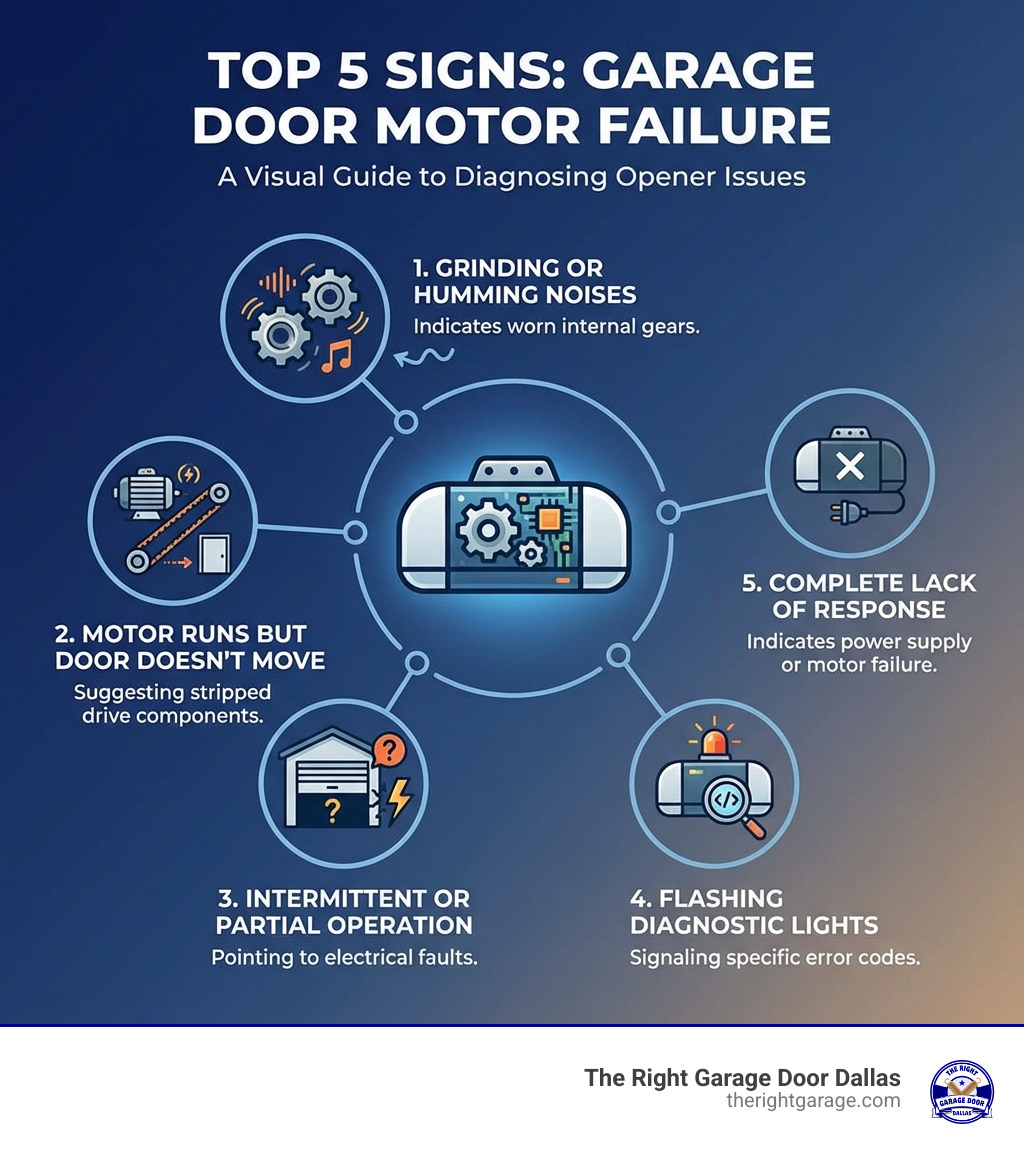
Is Your Motor the Culprit? Diagnosing Common Symptoms
When your opener acts up, it’s important to diagnose the problem correctly. Recognizing the symptoms of a failing motor helps prevent inconvenient or unsafe breakdowns.
Here are the common signs that a garage door opener motor needs repair:
- Unusual Noises (Grinding, Humming, Clunking): A grinding sound can point to worn gears within the motor. A persistent hum without door movement usually means the motor is getting power but can’t engage, possibly due to stripped gears. While squeaking often means other parts need lubrication, it can be amplified by motor strain.
- Intermittent Operation: If your door opens halfway, stops, or reverses unexpectedly, it might signal a faulty logic board, an issue with travel limits, or safety sensors. If the motor operates sporadically, it could be an electrical issue within the motor assembly.
- Slow or Sluggish Movement: If your garage door used to zip open and now moves at a snail’s pace, the motor could be weakening. This can happen due to age, insufficient power, or increased resistance from other parts of the door system (like unbalanced springs or worn rollers).
- Motor Runs but Door Doesn’t Move: If you hear the motor running but the door doesn’t move, the main drive gear has likely stripped, or the chain/belt has broken. You might find plastic shavings near the motor unit.
- Flashing Lights on the Motor Unit: Many modern garage door openers use blinking LED lights on the motor housing to communicate diagnostic error codes. For example, a “1-1” error often points to a safety sensor issue, while “2-1 to 2-5” can indicate a logic board failure. We recommend checking your owner’s manual for specific code interpretations.
- Opener Won’t Respond to Remote or Wall Button: If your garage door opener is completely unresponsive, the problem could be anything from a simple power outage to a dead motor or a fried logic board. We’ll cover basic checks in the DIY section.
- Over 10-15 Years Old: While not a symptom per se, if your opener is nearing or past its 10-15 year lifespan, any of the above signs are more likely to indicate a failing motor or a system at the end of its functional life.
A 2023 CPSC study found that nearly 30% of residential garage door-related injuries resulted from motor issues, highlighting the importance of a functional motor for safety. If you’re experiencing any of these symptoms in your Dallas-Fort Worth home, it’s time to investigate.
Your First Line of Defense: DIY Troubleshooting Steps
Before calling for help, perform these simple troubleshooting steps. Many issues that seem like a serious garage door opener motor repair problem are actually easy fixes.
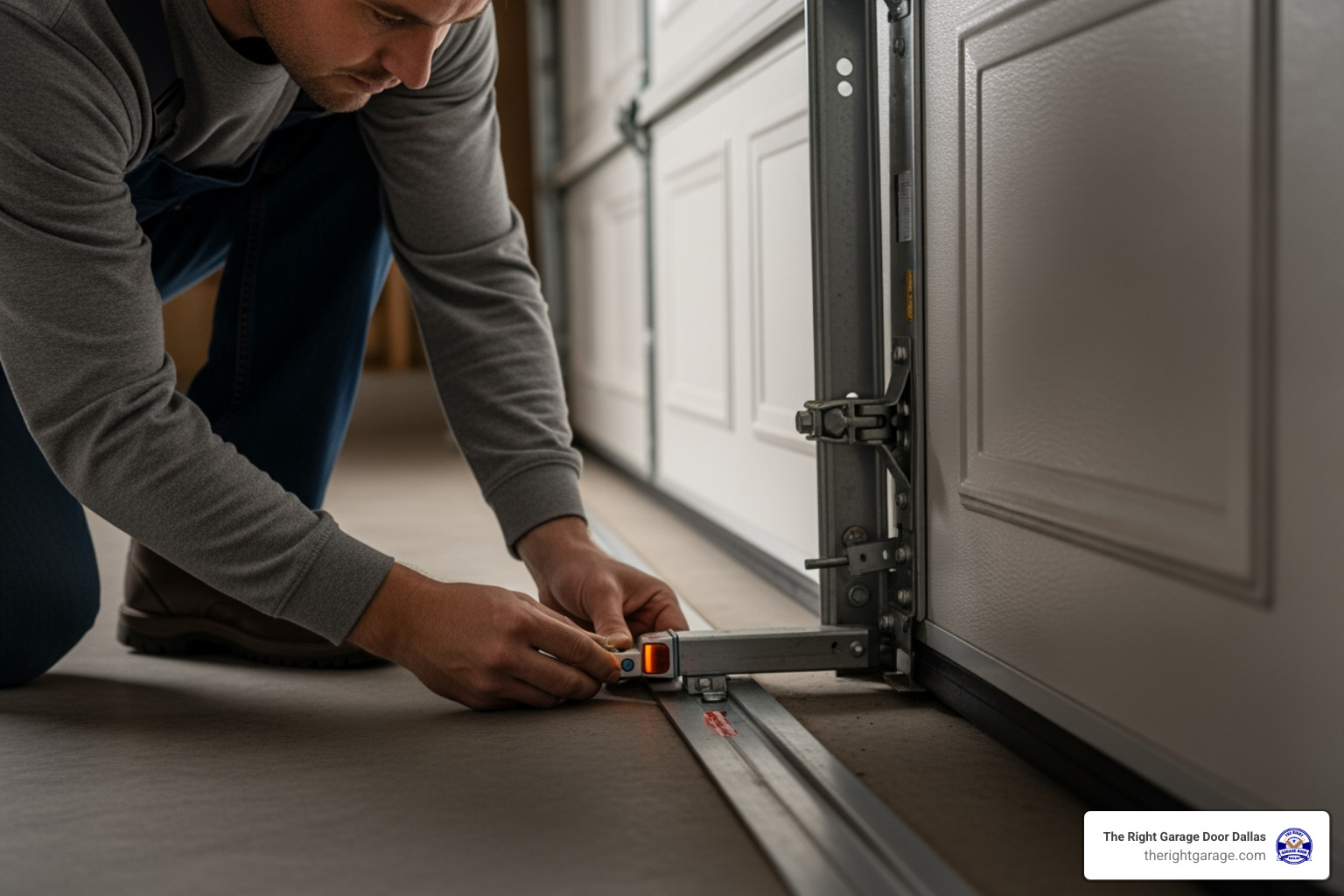
- Power Supply Check: This is often the simplest fix.
- Is it plugged in? Make sure the opener is securely plugged into a working outlet.
- Check the Circuit Breaker: Go to your home’s electrical panel and look for a tripped breaker. Reset it if necessary.
- Test the Outlet: Plug a lamp or small appliance into the same outlet to ensure it has power. If not, the issue might be with your home’s electrical system.
- Remote Control and Wall Button Test:
- Remote Batteries: Replace the batteries in your remote control. A dead battery is a common culprit.
- Signal Interference: Nearby radio signals or even some LED light bulbs can interfere with your remote. Try activating the opener from different distances.
- Wall Button: Test the wall-mounted button. If the remote doesn’t work but the wall button does, the problem is likely your remote. If neither works, the issue is closer to the opener unit.
- Safety Sensor Alignment and Cleaning: These small photo-eye sensors are located near the floor on either side of your garage door track.
- Clean the Lenses: Dust, dirt, or spiderwebs can block the sensor’s beam. Gently wipe the lenses with a soft cloth.
- Check Alignment: The sensors must be perfectly aligned. Look for indicator lights on each sensor (usually a steady green light means they are aligned). If a light is off or blinking, gently adjust the sensor until the light becomes steady. A misaligned sensor will prevent the door from closing.
- Manual Release Cord Test: This is the red cord hanging from your opener’s carriage.
- Disengage the Door: Pull the cord to disengage the opener from the door. Now, try to open and close the door manually.
- Door Balance: If the door feels extremely heavy or difficult to move manually, your garage door springs might be broken or out of balance. This is a major problem that requires professional attention. Never try to fix springs yourself!
- Checking for Physical Obstructions on the Track: Look along the entire path of the garage door, including the tracks and rollers. A stray tool or debris can prevent the door from moving.
These steps can often resolve minor issues. If they don’t work, the problem may be with the motor or its components.
The Nuts and Bolts: A Guide to Garage Door Opener Motor Repair
A garage door opener motor converts electricity into motion to lift your door. Understanding its components and types helps diagnose any needed garage door opener motor repair.
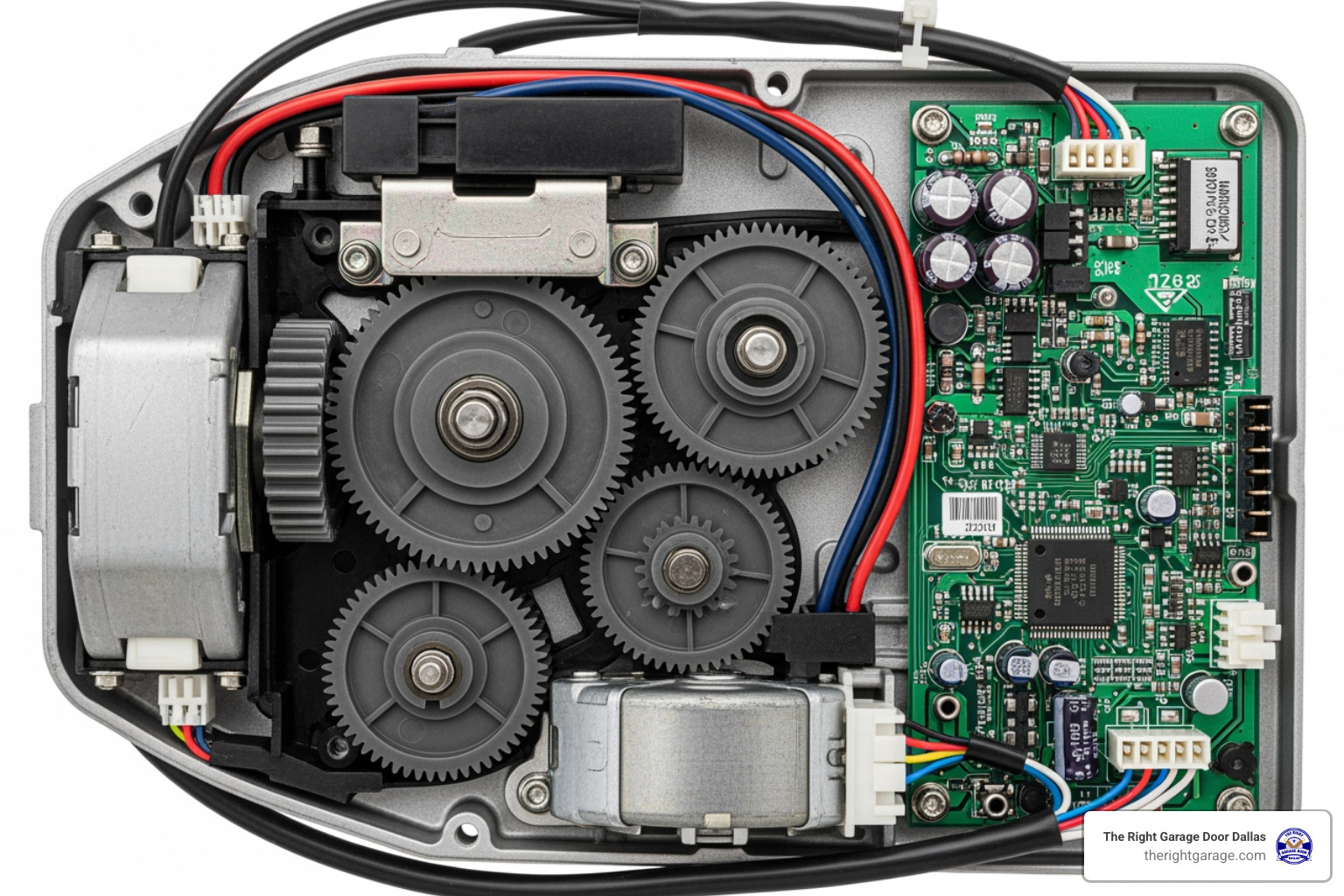
Key components within the motor unit typically include:
- The Motor Itself: The electric engine that provides the power.
- Drive Gears and Sprockets: These transfer the motor’s power to the drive system. Often made of plastic, they are a common point of failure.
- Logic Board (Circuit Board): The “brain” of the opener, controlling all functions.
- Capacitor (Start Capacitor): Provides an initial burst of energy to get AC motors running. A failing capacitor can cause the motor to hum without moving.
- Limit Switches/Sensors: Tell the motor when to stop the door.
- RPM Sensor: Monitors the motor’s rotation speed, often used in DC motors.
We work with all types of garage door opener motors in the Dallas-Fort Worth area, including:
- Chain-Drive Openers: Durable and budget-friendly, but also the noisiest.
- Belt-Drive Openers: Offer quieter, smoother operation, making them ideal for attached garages.
- Screw-Drive Openers: Have fewer moving parts but can be noisy if not lubricated.
- Jackshaft Openers (Wall-Mounted): Mount on the wall to maximize overhead space.
For more information about our repair process and the types of openers we service, visit our services page.
Understanding the Parts for Garage Door Opener Motor Repair
When the motor unit is the problem, it often boils down to a few specific components:
- Worn-Out Gears and Sprockets: Over years of use, plastic gears can strip, causing the motor to run but the chain/belt to remain stationary. You might see plastic shavings on the floor. Replacing these gears can be a DIY project, but it requires careful disassembly.
- Faulty Logic Board: A logic board can fail from power surges or age, causing erratic behavior or a complete lack of response. Diagnosing and replacing a logic board is complex and often requires a professional. Certain error codes, like LiftMaster’s 2-1 to 2-5, often point to logic board failure.
- Failed Start Capacitor: If your AC motor hums but the door doesn’t move (and the gears are fine), a failed start capacitor might be the culprit. This component provides the initial “kick” to get the motor turning. Replacing it requires electrical knowledge and safety precautions.
Safety Precautions: Before any internal garage door opener motor repair, always disconnect power by unplugging the unit or flipping the circuit breaker. Perform repairs with the door disconnected from the opener and in the closed position to prevent accidental movement.
For an in-depth look at how a motor replacement might work, you can see an example of motor replacement instructions for a specific Genie model. These instructions are model-specific, and your unit may differ.
Basic Maintenance to Extend Motor Life
Routine care helps your motor last its full 10-15 year lifespan. Lack of maintenance can shorten it significantly.
Here’s a list of essential maintenance tasks:
- Lubricating Moving Parts: Every few months, apply a silicone-based lubricant (not WD-40) to the hinges, rollers, and springs to reduce friction and motor strain.
- Tightening Hardware: Vibration can loosen hardware. Periodically check and gently tighten all hardware on the tracks, brackets, and opener unit.
- Testing Door Balance: Disengage your opener and manually lift the door halfway. It should stay put. If it drifts, your springs are out of balance, straining your motor. This requires professional spring adjustment.
- Cleaning Components: Keep safety sensors and the motor unit exterior clean of dust and debris.
- Check and Replace Remote Batteries: Weak remote batteries can cause inconsistent operation.
- Annual Professional Tune-up: Consider an annual tune-up with a professional in the Dallas-Fort Worth area. They can identify minor issues early, lubricate parts, and ensure all safety features are working correctly.
You can find more detailed information and tips on our FAQ page.
Repair vs. Replace: Making the Smart Financial Decision
When facing a significant garage door opener motor repair, a common question arises: should we repair it, or is it time for a full replacement? This decision often comes down to cost, age, and the benefits of new technology.
| Feature | Repair | Replace |
|---|---|---|
| Cost | Generally lower (parts + labor) | Higher initial cost (new unit + installation) |
| Age of Opener | Ideal for newer units (under 7-8 years old) | Recommended for older units (10+ years) |
| Frequency of Repairs | Good for one-off issues | Better if constantly breaking down |
| Part Availability | Depends on model; older parts can be hard to find | Guarantees new parts and latest models |
| Technology | Keeps existing features | Upgrades to Wi-Fi, battery backup, quieter operation, better security |
| Warranty | Repair may or may not come with a warranty | New unit comes with manufacturer and installation warranty |
Cost Analysis: The typical cost of garage door opener motor repair can vary widely based on the specific part needed and labor. For a complete opener replacement in our service areas of Dallas, Fort Worth, Plano, Frisco, Richardson, Irving, Carrollton, Garland, Mesquite, Grand Prairie, Addison, and North Texas, homeowners typically spend an average range of $400–$900, including labor. This range depends on the type of motor (chain, belt, smart/Wi-Fi enabled) and features. While repairing a stripped gear might be $150-$300, a new logic board could be $300-$500, pushing it closer to replacement costs.
Age of the Opener: Most garage door motors are designed to last 10-15 years. If your opener is approaching or has exceeded this lifespan, and a major component like the motor or logic board fails, replacement often makes more sense. An older unit is more likely to experience subsequent failures soon after a repair.
Frequency of Repairs: If you find yourself calling for garage door opener motor repair every few months, it’s a sign that your unit is simply wearing out. The cumulative cost of frequent repairs can quickly surpass the cost of a new, reliable opener.
Availability of Parts: For older models, finding compatible replacement parts can be challenging or even impossible. Manufacturers often discontinue parts for older units, making a repair unfeasible.
Benefits of New Technology: Modern garage door openers offer significant advantages:
- Improved Security: Newer models often use rolling code technology, which changes the access code each time the remote is used, making it much harder for unauthorized access compared to older fixed-code systems.
- Quieter Operation: Belt-drive openers are significantly quieter than older chain-drive models, a huge plus for attached garages.
- Smart Home Integration: Many new openers come with Wi-Fi connectivity, allowing you to control and monitor your garage door from your smartphone, receive alerts, and even integrate with other smart home devices.
- Battery Backup: Essential during power outages, a battery backup system ensures you can still open and close your garage door.
- Energy Efficiency: Newer motors are often more energy-efficient, saving you a few dollars on your utility bill over time.
If your opener is old, constantly breaking down, or the repair cost is more than half the price of a new unit, investing in a new garage door opener is often the smarter, more cost-effective long-term solution for your Dallas-Fort Worth home.
When to Call for Backup: Professional Repair Insights
While many troubleshooting steps are DIY-friendly, professional help for garage door opener motor repair is sometimes essential for safety and effectiveness. Knowing when to call an expert can save you time, money, and prevent hazards.
Here are key situations when it’s necessary to call a professional:
- Complex Electrical Issues: Problems with the logic board, wiring, or capacitor are best handled by licensed technicians. Working with electrical components is dangerous without proper training.
- When DIY Feels Unsafe: If you feel uncomfortable or unsure, stop. Your safety is paramount.
- Lack of Proper Tools: Some repairs require specialized tools. If you don’t have them, a professional service is the way to go.
- Persistent Problems After DIY Efforts: If you’ve tried the basic fixes and the problem persists, it’s time for an expert diagnosis.
- Spring Issues: Never attempt to repair or adjust garage door springs. They are under extreme tension and can cause serious injury. If you suspect a spring issue, call a professional immediately.
- 70% Faster Diagnosis by Specialists: A 2023 survey found that specialized technicians resolve issues 70% faster on average than general handymen, saving you time and preventing further damage.
Our team at The Right Garage Door Dallas is comprised of licensed technicians with experience in the Dallas-Fort Worth area, equipped to handle any garage door opener motor repair. Learn more about our team.
The Benefits of Professional Garage Door Opener Motor Repair
Choosing professional services for your garage door opener motor repair offers several advantages:
- Expert Diagnosis: Our licensed technicians accurately diagnose the problem quickly, saving time and preventing unnecessary part replacements.
- Access to High-Quality Parts: We use high-quality, manufacturer-recommended parts to ensure a reliable, long-lasting repair.
- Safety Compliance and Testing: After a repair, we perform comprehensive safety checks to ensure your door operates safely and meets all industry standards.
- Warranty on Parts and Labor: Reputable companies like ours offer warranties on parts and labor, protecting your investment.
- Time and Hassle Savings: Our professionals complete repairs quickly, often with same-day service in the Dallas-Fort Worth area, getting your door working again swiftly.
Frequently Asked Questions about Garage Door Motors
How long should a garage door opener motor last?
A garage door opener motor typically lasts 10-15 years. Heavy use, extreme Texas weather, power surges, and poor maintenance can shorten this. Regular maintenance like lubrication and ensuring door balance helps it last longer.
What are the main types of garage door opener motors?
There are four main types of garage door opener motors:
- Chain-Drive: Durable and affordable, but noisy.
- Belt-Drive: Quieter and smoother, ideal for attached garages.
- Screw-Drive: Low maintenance but can be noisy and sensitive to temperature.
- Jackshaft (Wall-Mounted): Saves overhead space and is very quiet.
Can I just replace the motor, or do I need a whole new opener?
Whether to replace just the motor or the whole opener depends on several factors:
- Age and Model: For newer openers (under 7-8 years), a targeted garage door opener motor repair is often cost-effective. For older units (10+ years), parts may be hard to find, and a full replacement is often a better investment as other components are also likely worn.
- Part Availability: For some models, individual motor components are available, while for others, the entire powerhead assembly must be replaced.
- Cost-Effectiveness: Compare the repair cost (parts + labor) to the cost of a new opener. If the repair is more than 50% of a new unit’s cost, or if the unit is old, a replacement offers better value with new features and a warranty.
Get Your Garage Door Running Smoothly Again
We hope this extensive guide has empowered you with the knowledge to troubleshoot and understand your garage door opener motor. From recognizing the tell-tale signs of trouble to performing basic DIY checks, you’re now better equipped to handle common issues.
While many minor problems can be resolved with a little elbow grease, some complex issues, especially those involving springs or intricate electrical components, are best left to the professionals. Your safety and the long-term functionality of your garage door are our top priorities.
For reliable and fast garage door opener motor repair and replacement services in the Dallas-Fort Worth area, trust The Right Garage Door Dallas. Our licensed technicians are ready to provide expert diagnosis and efficient solutions. Don’t let a malfunctioning garage door disrupt your day.


