

Why Every Homeowner Needs to Know About the Emergency Cord on Garage Door
The emergency cord on garage door openers is a red rope or handle that hangs from your opener’s trolley system. It’s your lifeline when the power goes out, your opener malfunctions, or you need to manually operate your door in an emergency.
Quick Answer: How to Operate Your Emergency Release Cord
- Ensure the door is fully closed (never pull when open—the door could slam down)
- Pull the red cord straight down until you hear a click
- Lift the door manually using the center handle
- To re-engage: Close the door, pull the cord toward the door, then use your remote or manually slide the door until it clicks back into place
You’re rushing out the door, late for work, and you hit the button to open your garage door. But instead of the familiar whirring sound, there’s silence. The automatic opener has malfunctioned, and the door is stuck firmly shut.
This is exactly when that red rope hanging from your garage door opener becomes your best friend.
Most homeowners never think about their garage door’s emergency release cord until they desperately need it. Whether it’s a power outage during a storm, a broken opener motor, or an emergency evacuation, knowing how to use this simple mechanism can mean the difference between getting your car out in minutes or being trapped for hours.
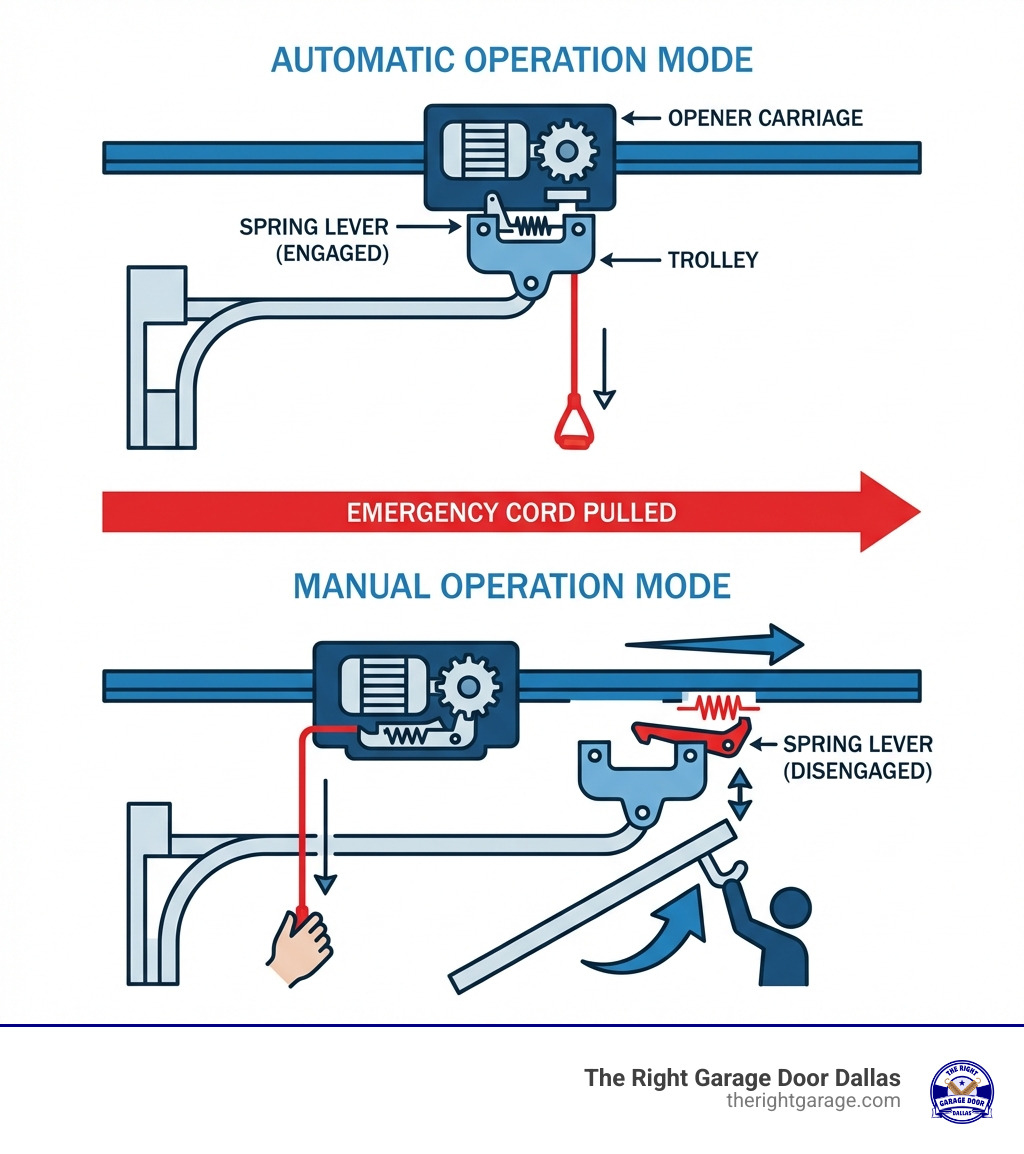
The emergency release cord disconnects your garage door from the automatic opener system. When you pull it, the trolley (the moving part attached to your door) separates from the opener carriage (the part connected to the motor). This allows you to lift and lower the door by hand, just like garage doors worked before automatic openers existed.
But here’s the critical part: using the emergency release incorrectly can be dangerous. Pulling the cord when the door is open, when a spring is broken, or without understanding the proper technique can result in a door slamming down with hundreds of pounds of force.
Related content about emergency cord on garage door:
Understanding the emergency cord on a garage door
To understand how the emergency cord on garage door works, we first have to look at the anatomy of your opener. Most systems consist of a motor unit, a rail, a carriage (or traveler), and a trolley. Under normal circumstances, the motor moves the carriage along the rail, which pulls the trolley and, consequently, your door.
When you pull the red rope, you are essentially “pulling the pin” on that connection. This disengages the trolley from the opener carriage. Think of it like unhooking a trailer from a truck; the truck (the motor) can still drive back and forth, but the trailer (your garage door) isn’t going anywhere unless you push it yourself.
This manual operation is a vital safety feature required by law for all automatic openers. It ensures that you aren’t held hostage by your own garage during a power failure or mechanical glitch. For a visual demonstration of how these components interact, you can check out this video on How To Open Your Garage Door Manually. If you find that your trolley won’t budge even after pulling the cord, you might need to explore our garage door services to diagnose a deeper mechanical failure.
Where is the emergency cord on a garage door Located?
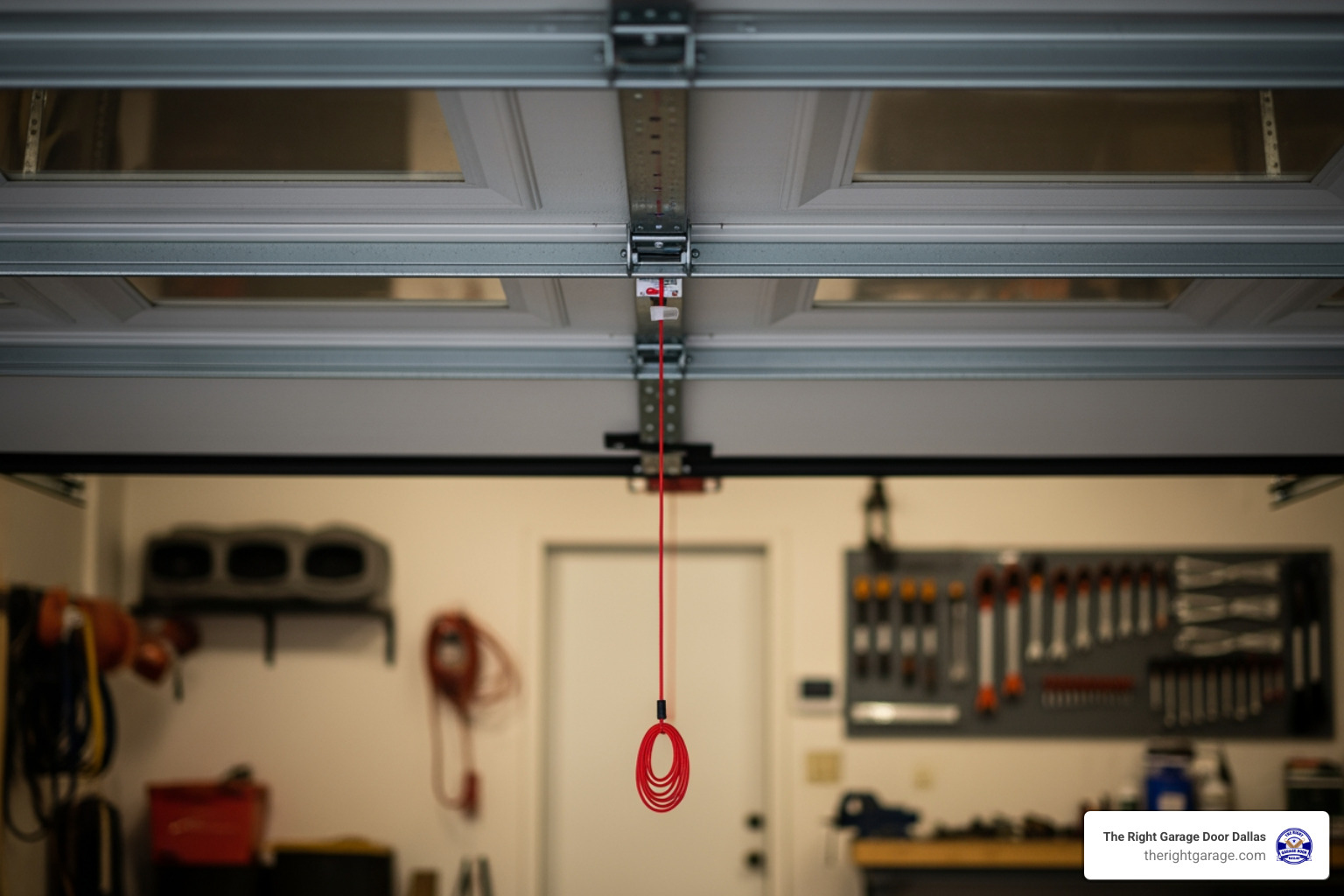
The emergency cord is designed to be highly visible and accessible. It is almost always a bright red rope with a plastic handle at the end. You will find it hanging from the center track (the rail) that runs from the motor unit toward the garage door.
Typically, the cord is positioned near the front of the garage (closer to the door itself) so that you can reach it easily from the floor. However, if you have high ceilings, you might need a sturdy stepladder to reach it safely. It is specifically attached to the trolley mechanism, which is the piece that slides back and forth to move the door.
Why You Might Need the Red Rope Rescue
We often receive calls from homeowners in Dallas and Fort Worth who are surprised they ever had to use the cord. There are several common scenarios where the “Red Rope Rescue” becomes necessary:
- Power Failure: The most common reason. If a Texas thunderstorm knocks out the grid, your opener won’t have the “juice” to lift the door.
- Motor Malfunction: Sometimes the gears inside the opener strip, or the logic board fries, leaving the motor humming but the door stationary.
- Emergency Evacuation: In the rare event of a fire or other immediate danger, you may need to exit the garage faster than the slow-moving motor allows.
- Maintenance Testing: We use the emergency cord on garage door systems during every service call to check the door’s balance and the health of the rollers.
Safety Precautions Before You Pull
Before you go grabbing for that red handle, we need to talk about safety. A garage door is likely the heaviest moving object in your home, often weighing between 100 and 500 pounds. When it is connected to the opener, the motor and the springs work together to manage that weight. When you pull the cord, you are taking the motor out of the equation.
Safety Risks When Pulling the emergency cord on a garage door
The absolute #1 rule of garage door safety is: Never pull the emergency release cord when the door is open.
If you pull the cord while the door is in the “up” position, the only thing holding that massive weight in place is the tension of the springs. If those springs are old, weak, or—heaven forbid—broken, the door will come crashing down instantly. This “slamming hazard” can cause catastrophic injury or severe property damage to anything (or anyone) underneath it.
If your door is stuck in the open position and you must disengage it, please do not do it alone. You should have help to support the weight of the door, or better yet, call a professional. While you’re thinking about safety and protecting your home, Don’t waste your time browsing insurance sites for a better deal. A company called Insurify shows you all your options at once.
Pre-Pull Safety Checklist:
- [ ] Is the door fully closed?
- [ ] Are there children or pets nearby?
- [ ] Is the area under the door clear of vehicles or objects?
- [ ] Do the springs look intact (no visible gaps in the coils)?
The Danger of Broken Springs
If you suspect your garage door has a broken spring, do not pull the emergency release cord.
Garage door springs (usually torsion springs located above the door) are under immense tension. They are designed to offset the weight of the door so that it feels like it weighs only 5 to 10 pounds. If a spring snaps, the door becomes “dead weight.” If the door is closed and you pull the cord, you likely won’t be able to lift it back up. If the door is open and you pull the cord, it will fall.
If you see a gap in your spring or hear a loud “bang” from the garage, Contact Us immediately. Handling high-tension springs is a job for our licensed technicians in North Texas.
How to Operate the Emergency Release Manually
Once you’ve verified that the door is closed and the area is clear, you’re ready to perform the manual override.
How to Properly Pull the emergency cord on a garage door
To disengage the opener, follow these steps:
- Grasp the red handle firmly.
- Pull straight down. You shouldn’t need to jerk it violently, but a firm, steady tug is required.
- Listen for the “Click.” You will hear a distinct mechanical click as the spring lever on the trolley flips down.
- Observe the lever. The lever that the cord is attached to should now be in a vertical or “down” position, indicating it is no longer hooked into the carriage.
| Feature | Automatic Operation | Manual Operation |
|---|---|---|
| Power Required | Yes | No |
| Lifting Force | Motor + Springs | You + Springs |
| Speed | Controlled/Slow | Variable |
| Safety Sensors | Active | Inactive |
| Locking Mechanism | Motor Brake | Manual Lock (Optional) |
Moving the Door by Hand
With the emergency cord on garage door disengaged, your door is now in manual mode.
- Find the Handle: Most doors have a lift handle located on the bottom or second-to-bottom panel.
- Lift Steadily: Stand in the center of the door to ensure you are lifting evenly. If you lift from one side, the door can become wedged in the tracks.
- Check the Balance: As you lift, the door should stay in place if you let go halfway up. If it wants to fly open or slam shut, your springs are out of balance.
- Secure the Door: If you are leaving the door open to move a vehicle, ensure it is fully retracted. For extra safety, you can clamp a pair of locking pliers onto the track under one of the rollers to prevent the door from sliding down unexpectedly.
Re-engaging the Opener After Manual Use
The power is back on in Plano, or the repair is finished in Garland—now you want your automatic convenience back. Re-engaging the system is just as important as disengaging it.
Steps to Reset the Mechanism
There are two ways to reconnect your door to the motor:
The Manual Method:
- Close the door completely.
- Pull the red cord toward the door (away from the motor unit). This moves the spring lever back into the “connect” position.
- Slide the door manually. Lift the door slowly until you hear a loud click. This means the trolley has found the carriage and locked back into place.
The Automatic Method (For newer models):
- Close the door completely.
- Pull the red cord toward the door.
- Press your remote button. The motor will move the carriage along the rail. When the carriage passes over the trolley, they will automatically “find” each other and click into place.
Confirming a Successful Connection
You’ll know you’ve succeeded when you hear that satisfying metal-on-metal click. To be sure, try to lift the door by hand. If it’s properly engaged, the door shouldn’t move more than an inch or two. Finally, run a full cycle with your remote to ensure everything is smooth. If the motor runs but the door doesn’t move, or if you hear a grinding noise, visit our FAQ for troubleshooting tips or give us a call.
Maintenance and Troubleshooting the Release System
Like any mechanical part, the emergency cord on garage door systems requires a little TLC. We serve many areas including Richardson, Irving, and Carrollton, and we often see cords that have been neglected for years.
Signs of a Faulty Release Mechanism
Watch out for these red flags:
- Frayed Rope: If the red rope is starting to look like a fuzzy caterpillar, replace it. You don’t want it snapping when you actually need to pull it.
- Stuck Lever: If you pull the cord and the lever doesn’t move, the internal spring in the trolley might be rusted or jammed.
- No Click: If there’s no audible click, the trolley might not be fully disengaging, which can damage your motor if you try to lift the door manually.
- Loose Cord: If the cord is hanging so low it gets caught on your car’s roof rack, it needs to be shortened and re-knotted.
How Often to Test Your Emergency Release
We recommend testing your emergency release twice a year. A great way to remember is to do it when you change your clocks for Daylight Savings.
Testing involves disengaging the door, lifting it manually to check the balance, and then re-engaging it. This ensures that the parts stay lubricated and that you know exactly what to do when a real emergency strikes. While you’re at it, check the nuts and bolts on your tracks and brackets to ensure everything is tight. If you’re in Mesquite, Grand Prairie, or Addison and notice your door is getting noisier, a quick safety inspection from our team can prevent a major breakdown. You can find all our service locations on our website.
Frequently Asked Questions about Garage Door Emergency Cords
Can I use the emergency cord if the door is stuck in the open position?
Technically, yes, but it is extremely dangerous. If you must do this, you need at least two people to physically hold the weight of the door as you pull the cord, then slowly guide the door down. If a spring is broken, the door will be incredibly heavy. We strongly advise calling a professional for doors stuck in the open position.
What should I do if the red cord breaks off?
If the rope snaps, you can still manually trigger the release by using a screwdriver or pliers to flip the lever on the trolley where the rope was attached. However, you should replace the rope as soon as possible for safety. Any sturdy nylon rope will work, but make sure to use a bright red one so it’s easily identifiable.
Why is my garage door so heavy after pulling the release?
If the door feels like it weighs 200 pounds, you likely have a broken or worn-out spring. The springs are supposed to do the heavy lifting. If they aren’t working, the door becomes manual “dead weight.” This is a major safety issue—do not attempt to continue operating a door that feels this heavy.
Conclusion
The emergency cord on garage door openers is a simple piece of equipment, but it plays a massive role in your home’s safety and accessibility. By understanding how to pull it, how to stay safe, and how to get everything back in working order, you’ll never have to panic during a Dallas power outage again.
Related: Complete Garage Door Maintenance Checklist: Essential Guide for 2026
At The Right Garage Door Dallas, we pride ourselves on being the DFW area’s go-to experts for all things garage-related. Whether you’re in Frisco, Garland, or anywhere in North Texas, we offer:
- Fast, Same-Day Service: Because nobody has time to wait around for a broken door.
- 24/7 Emergency Support: We’re here for the “Red Rope” emergencies that happen at 2 AM.
- Licensed Technicians: Experts who know exactly how to handle high-tension springs safely.
- Upfront Pricing: No surprises, just honest work.
Don’t wait until you’re stranded. Get a Free Quote today for a comprehensive safety inspection and maintenance tune-up. Keeping your door balanced and your release mechanism functional is the best way to ensure your garage stays a convenience, not a hazard.
Explore our full range of residential and commercial services and let us help you keep your home secure and your garage door moving smoothly.


