

Why Heavy Duty Garage Door Springs Matter for Dallas Homeowners and Businesses
Heavy duty garage door springs are high-strength counterbalance springs engineered to handle greater door weight, higher usage frequency, and longer service life than standard springs.
Here’s a quick breakdown of what sets them apart:
| Feature | Standard Springs | Heavy Duty Springs |
|---|---|---|
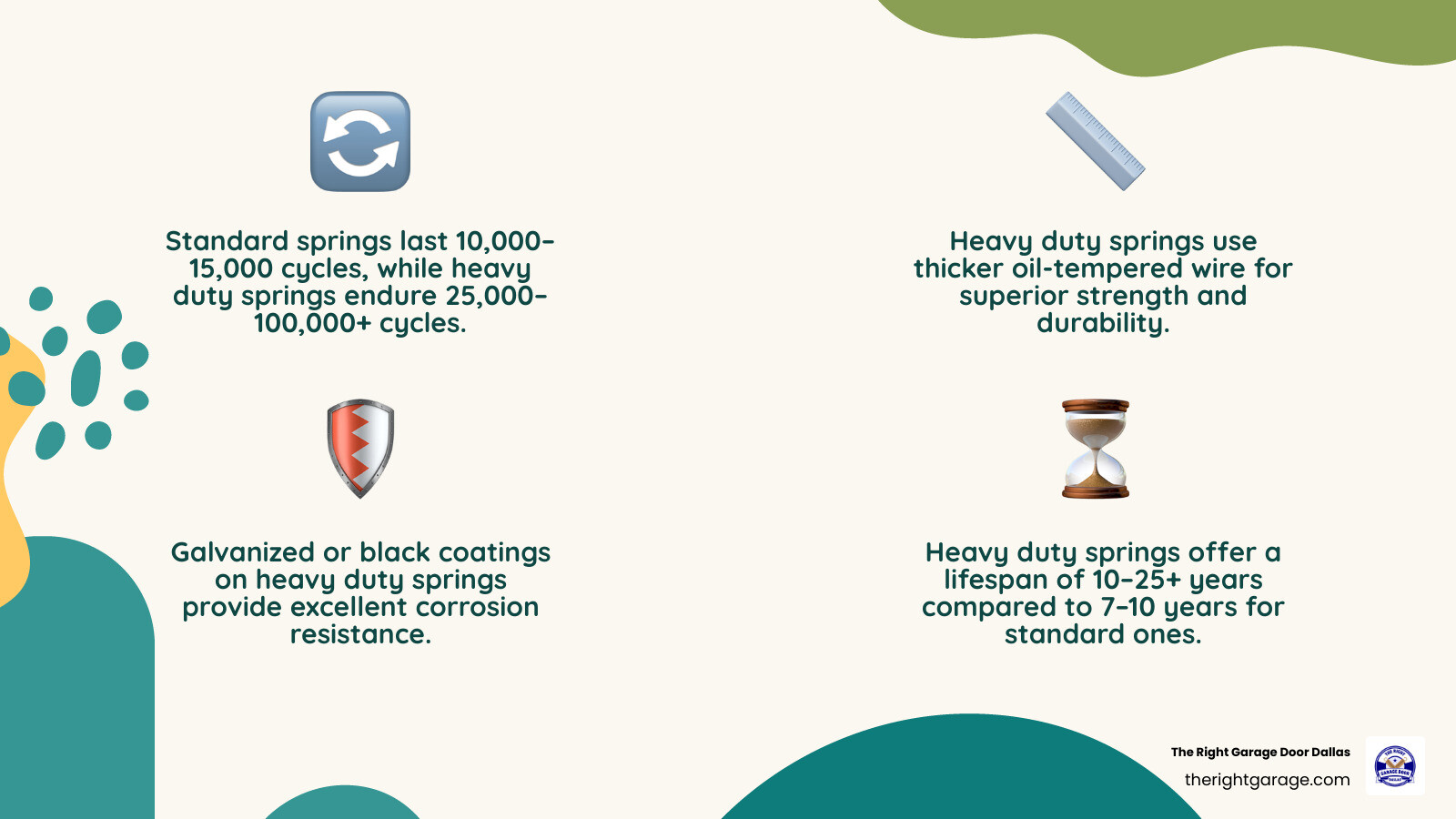
| Cycle life | 10,000–15,000 cycles | 25,000–100,000+ cycles |
| Best for | Light residential doors | Heavy, oversized, or high-use doors |
| Wire gauge | Thinner wire | Thicker, oil-tempered wire |
| Coating | Basic or none | Galvanized or black-coated |
| Lifespan | 7–10 years | 10–25+ years |
Most garage doors don’t announce their problems quietly. A sudden loud bang from your garage — the sound of a spring snapping under tension — is one of the most jarring things a homeowner can experience. And if your door is large, heavy, or gets used dozens of times a day, a standard spring simply may not hold up for long.
That’s where heavy duty springs come in. They’re built to last, and choosing the right one makes a real difference in how long your door stays safe and functional.
This guide covers everything you need to know: spring types, key specs, signs you need an upgrade, and what to watch out for when buying or replacing them.
Heavy duty garage door springs terminology:
What Are Heavy Duty Garage Door Springs?
When we talk about heavy duty garage door springs, we are referring to the muscle of your garage door system. While the opener does the “thinking,” the springs do the heavy lifting. A standard residential spring is typically designed to last about 10,000 cycles (one cycle is one opening and one closing). For a family in Plano or Frisco that uses the garage as the main entrance, those 10,000 cycles can disappear in as little as five to seven years.
Heavy duty springs differ from standard ones in several key ways:
- Wire Gauge: They utilize a thicker wire diameter. In springs, a larger wire size often means more “lift” and a significantly longer lifespan.
- Material Quality: Most heavy duty options are made from high-grade oil-tempered steel. This material is heated and quenched in oil to create a spring that is incredibly resilient and less likely to deform under constant tension.
- Corrosion Resistance: In North Texas, humidity can lead to surface rust. Many Garage Door Springs – Types & Manufacturing processes now include galvanized or black-coated finishes. Galvanized springs are coated in zinc to prevent rust, while black-coated springs are often cleaner to handle and offer excellent protection against the elements.
- Cycle Life: This is the most significant differentiator. While a standard spring might be rated for 10,000 cycles, heavy duty versions can be engineered for 25,000, 50,000, or even 100,000 cycles.
Torsion vs. Extension: Which is Better for Heavy Duty Applications?
If you are looking for a heavy duty solution, the debate between torsion and extension springs usually has a clear winner.
Torsion Springs
These are mounted on a metal shaft directly above the door opening. They work by twisting (rotational torque). When the door closes, cables attached to the bottom corners pull on the drums, winding the spring. When you open the door, the spring unwinds, releasing that stored energy to lift the weight.
- Pros: They are much safer because if they break, they stay on the shaft rather than flying across the garage. They also distribute weight more evenly and typically last twice as long as extension springs.
- Heavy Duty Note: For doors over 300 pounds, we often recommend a two-spring garage door spring conversion. Using two matched springs instead of one giant one provides better balance and prevents the door from “walking” or twisting during operation.
Extension Springs
These are the long, skinny springs that run along the horizontal tracks on either side of the door. They work by stretching out.
- Cons: Because they act like giant rubber bands under extreme tension, they are inherently more dangerous. If an extension spring breaks without a safety cable, it can cause severe damage to property or people.
- Heavy Duty Note: While heavy duty extension springs exist (often color-coded for weight capacity, such as gold for 180 lbs), they are rarely the first choice for high-cycle or industrial applications.
In almost every “heavy duty” scenario—whether it’s a heavy wood carriage door in Highland Park or a commercial warehouse in Irving—torsion springs are the superior choice for safety and longevity.
Key Specifications for Heavy Duty Spring Selection
Selecting the right heavy duty garage door springs isn’t as simple as picking the biggest one on the shelf. It requires precise measurements. If the spring is too strong, the door will fly open or damage the opener; if it’s too weak, the opener will burn out trying to lift a dead weight.
To get it right, we look at four primary specs:
- Wire Size: We don’t just use calipers for this; we use the “20-coil count” method. By measuring the length of 20 coils and comparing it to a chart, we can determine the exact wire gauge (e.g., .250, .262, or .273). Even a tiny difference in wire size can change the spring’s lift capacity by dozens of pounds.
- Inside Diameter (ID): Most residential torsion springs have an ID of 1 3/4″ or 2″. Commercial and heavy duty industrial springs can go up to 3 3/8″ or 3 3/4″.
- Length: This is the measurement of the coils from end to end. It’s important to measure garage door torsion springs while they are unwound for accuracy, as springs “grow” in length when they are wound up.
- Wind Direction: Springs come in “Right Hand Wind” and “Left Hand Wind.” Usually, the spring on the left side (looking from inside the garage) is a right-hand wind (often with a red cone), and the one on the right is a left-hand wind (black cone).
Beyond these physical dimensions, we consider IPPT (Inches-Pounds Per Turn). This tells us exactly how much weight the spring will lift for every turn of tension applied. For heavy duty upgrades, we often select a spring with a larger wire and a longer length to achieve the same IPPT as your old spring but with a much higher cycle rating.
Understanding High-Cycle and Commercial-Grade Heavy Duty Garage Door Springs
For businesses in Carrollton or Grand Prairie, a “standard” spring is out of the question. Commercial doors often weigh between 500 and 1,000+ pounds and may open 50 times a day.
- 100,000 Cycle Springs: These are the gold standard for high-traffic environments. They are physically much larger than standard springs, often requiring extra shaft support brackets to handle the weight of the spring itself.
- Duplex and Triplex Systems: When a door is exceptionally heavy, a single spring might not fit on the shaft. In these cases, we use duplex systems, where a smaller spring is nested inside a larger one. This saves space while providing immense lifting power.
- Square Wire Springs: Often found in industrial settings, square wire provides more torque in a smaller footprint than traditional round wire.
- Rolling Steel Springs: These are specialized springs used for “roll-up” doors found in self-storage facilities or loading docks. They are often secured directly to the pipe or drum.
If you are a business owner, you likely already know why Dallas businesses trust commercial garage door repair experts; it’s because a broken spring doesn’t just mean a stuck car—it means a total halt in operations.
Identifying When You Need a Heavy Duty Upgrade
How do you know if your current springs are “standard” and failing, or if it’s time to step up to a heavy duty version?
Signs of Spring Failure
If you notice any of these top 5 signs you need garage door repair in Dallas TX, your springs are likely the culprit:
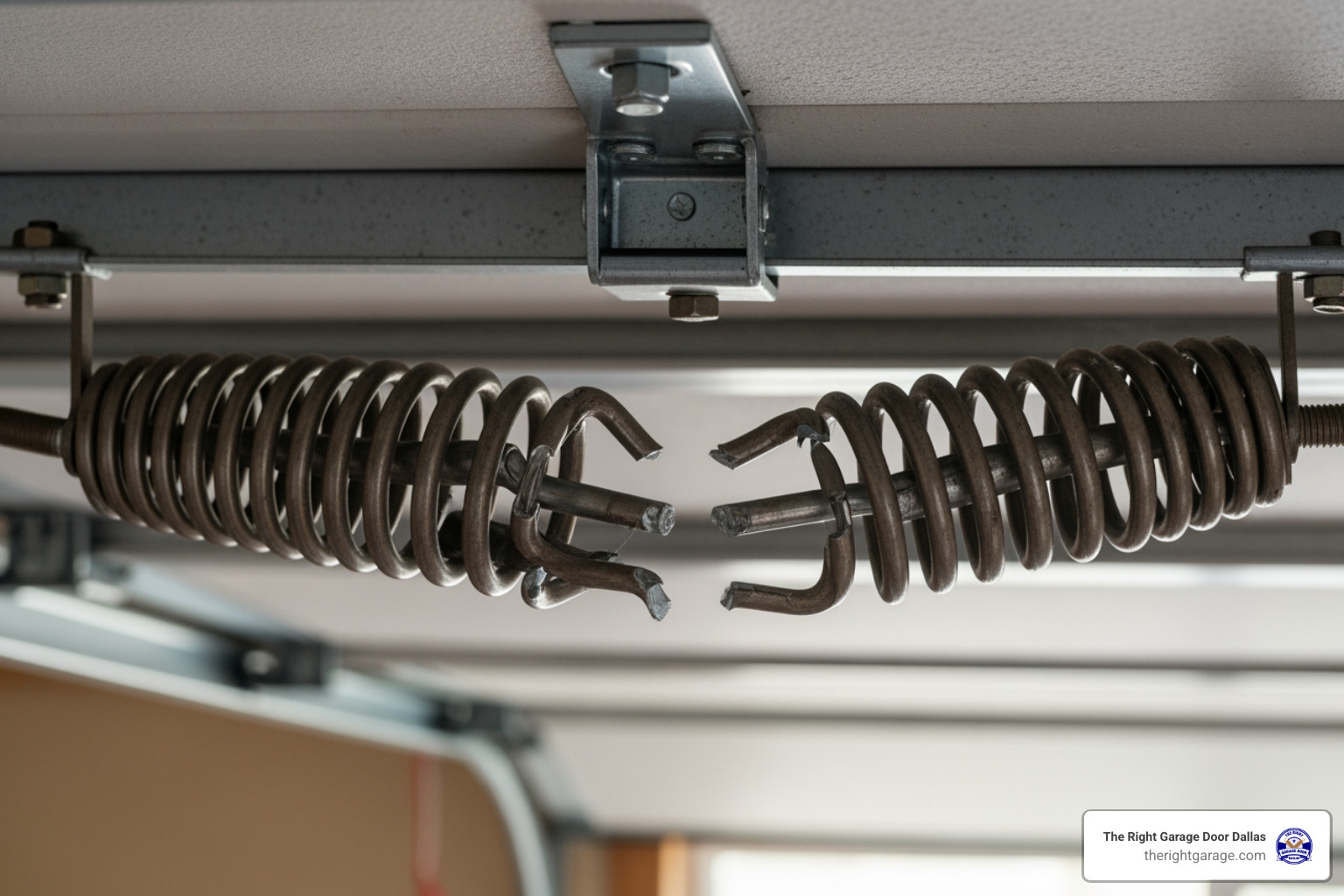
- The Loud Bang: If you heard a sound like a gunshot in the garage, that was the spring snapping.
- The 2-Inch Gap: Look at the coils above your door. If you see a physical gap in the spring, it is broken.
- Slow Operation: If your opener seems to be struggling or the door moves at a snail’s pace, the springs have lost their tension.
- Uneven Lifting: If one side of the door hangs lower than the other, you likely have one broken spring in a two-spring system.
- The Door “Feels” Heavy: Disconnect your opener and try to lift the door manually. A well-balanced door should be easy to lift with one hand and stay in place halfway up. If it crashes down, your springs are shot.
Why Upgrade to Heavy Duty?
You should consider an upgrade if:
- You Use the Garage as Your Front Door: If the door opens 10+ times a day, a standard spring will break in 3 years. A 50,000-cycle spring will last 15.
- You Have a Modern “Glass” or Solid Wood Door: These doors are significantly heavier than basic steel panels. Standard springs will wear out prematurely under the strain.
- You Recently Added Insulation or Struts: Adding weight to the door (like hurricane bracing or DIY insulation kits) changes the balance. You need a spring with a higher lift capacity to compensate.
Safety, Installation, and Maintenance of Heavy Duty Systems
We cannot stress this enough: Garage door springs are dangerous. A torsion spring is wound with enough force to lift a 200-pound door. If that energy is released uncontrollably, it can break bones, cause lacerations, or worse.
The Professional Process
When our licensed technicians install heavy duty garage door springs, we follow a strict safety protocol:
- Winding Bars: We use solid steel winding bars specifically sized for the cones. We never use screwdrivers or pliers, which can slip.
- Matched Pairs: We always recommend replacing both springs at the same time. If one has snapped, the other has undergone the same number of cycles and is likely days or weeks away from failing itself.
- Bearing Inspection: Heavy duty springs put more stress on the center bracket and end bearings. We inspect and often replace these to ensure the whole system runs smoothly.
Maintenance Tips
To get the most out of your investment, follow these steps:
- Lubrication: Use a specialized garage door silicone or lithium spray on the springs every six months. This prevents “spring ping” (the sound of coils rubbing) and keeps rust at bay.
- Tighten Hardware: Heavy duty springs vibrate. Periodically check that the bolts on the stationary and winding cones are tight.
- Professional Inspection: Have a pro check the balance of your door once a year. This ensures the springs are still providing the correct amount of lift. You can find more about our full range of garage door services to keep your system in top shape.
Common Mistakes When Purchasing Heavy Duty Garage Door Springs
Many DIY enthusiasts or inexperienced contractors make mistakes that can lead to using torsion springs with different lifts, which causes the door to rack or the cables to jump off the drums.
- Ignoring Door Weight: You cannot just “guess” based on door size. A 16×7 door can weigh 150 lbs or 400 lbs depending on the material. We use a scale to get the exact weight before selecting a spring.
- Mismatched Cycles: If you put a 10,000-cycle spring on one side and a 50,000-cycle spring on the other, the door will eventually become unbalanced as the weaker spring loses tension faster.
- Incorrect Inside Diameter: Using a 2″ ID spring on a shaft designed for 1 3/4″ can cause the spring to sag and rub against the shaft, leading to premature failure.
Frequently Asked Questions about Heavy Duty Springs
How much do heavy duty garage door springs cost?
The cost for professional spring replacement typically ranges from $150 to $350 per spring. Factors that affect pricing include the wire size, the cycle rating (a 100k cycle spring costs more than a 25k one), and the labor involved in the installation. While the upfront cost is higher than standard springs, the “cost per cycle” is significantly lower, making heavy duty springs a much better long-term ROI for Dallas homeowners.
How long do high-cycle springs actually last?
It depends on your “mileage.”
- Standard usage (2 cycles/day): A 50,000-cycle spring could theoretically last over 60 years.
- High usage (6-8 cycles/day): That same spring will last 17–20 years.
Environmental factors like the North Texas heat and humidity can play a role, but generally, you can expect a heavy duty spring to last at least twice as long as a standard one.
Can I replace just one spring if the other is still working?
We strongly advise against it. Garage door springs are like tires on a car; they wear out at the same rate. If you only replace the broken one, the older spring will likely break shortly after, requiring a second service call and more labor costs. Furthermore, a new spring and an old spring will have different tension levels, which can cause the door to lift unevenly and damage the tracks or rollers.
Conclusion
Related: Garage Door Spring Replacement Cost: 2026 Pricing Guide
Related: Garage Door Off Track Repair: DIY Fix or Pro Help?
Related: Garage Door Cable Repair Cost in 2026: Pricing Guide
Related: Garage Door Repair Dallas Texas: Complete 2026 Cost Guide and Expert Service Directory
Your garage door is likely the largest moving object in your home or business. Investing in heavy duty garage door springs is an investment in safety, reliability, and peace of mind. Whether you are in Dallas, Fort Worth, Plano, or anywhere in the North Texas area, choosing a high-cycle option means fewer repairs and a door that operates smoothly for decades.
At The Right Garage Door Dallas, we specialize in high-performance spring systems. We offer:
- Fast, same-day service to get your car out of the garage.
- Upfront pricing so there are no surprises.
- Licensed technicians who understand the physics of heavy doors.
- 24/7 emergency support because springs never break at a “convenient” time.
Don’t settle for a “standard” fix for a heavy duty problem. Contact us for expert installation or get a free quote today to see how we can upgrade your door with the strong, silent type of hardware it deserves. Explore our other expert garage door services to keep your home secure and functional.


