

Why Your Garage Door Torsion Spring is the Most Important Part You’ve Never Noticed
A garage door torsion spring is a tightly wound coil mounted horizontally above your garage door. It stores mechanical energy by twisting and releases it as rotational force (torque), making it possible to lift a 150-200 pound door with minimal effort. Without a functioning torsion spring, your garage door becomes too heavy to operate safely.
Quick Facts:
- Location: Mounted horizontally on a metal shaft above the door
- Function: Stores energy by twisting to counterbalance the door’s weight
- Lifespan: Typically 10,000 cycles (7-10 years for most homeowners)
- Safety: Safer than extension springs due to controlled, contained operation
- Replacement: Always requires professional service due to extreme tension
Garage doors often break at the worst possible time. That loud bang you heard from the garage? It was likely your torsion spring snapping. The spring is the unsung hero of your garage door system, doing all the heavy lifting. Your garage door opener doesn’t actually lift the door; it just triggers the movement. The torsion spring provides the counterbalance force that makes a 200-pound door feel nearly weightless.
Most homeowners never think about their torsion springs until they fail. But understanding how they work, recognizing the warning signs of wear, and knowing when to call a professional can save you from dangerous situations and major inconvenience.
In this guide, we’ll walk you through everything you need to know about garage door torsion springs—from basic mechanics to maintenance, safety, and replacement.
What is a Torsion Spring and How Does It Work?
At The Right Garage Door Dallas, we call the garage door torsion spring the muscle of the system. Contrary to popular belief, your opener doesn’t do the heavy lifting; the torsion spring provides the power to raise and lower your door smoothly.
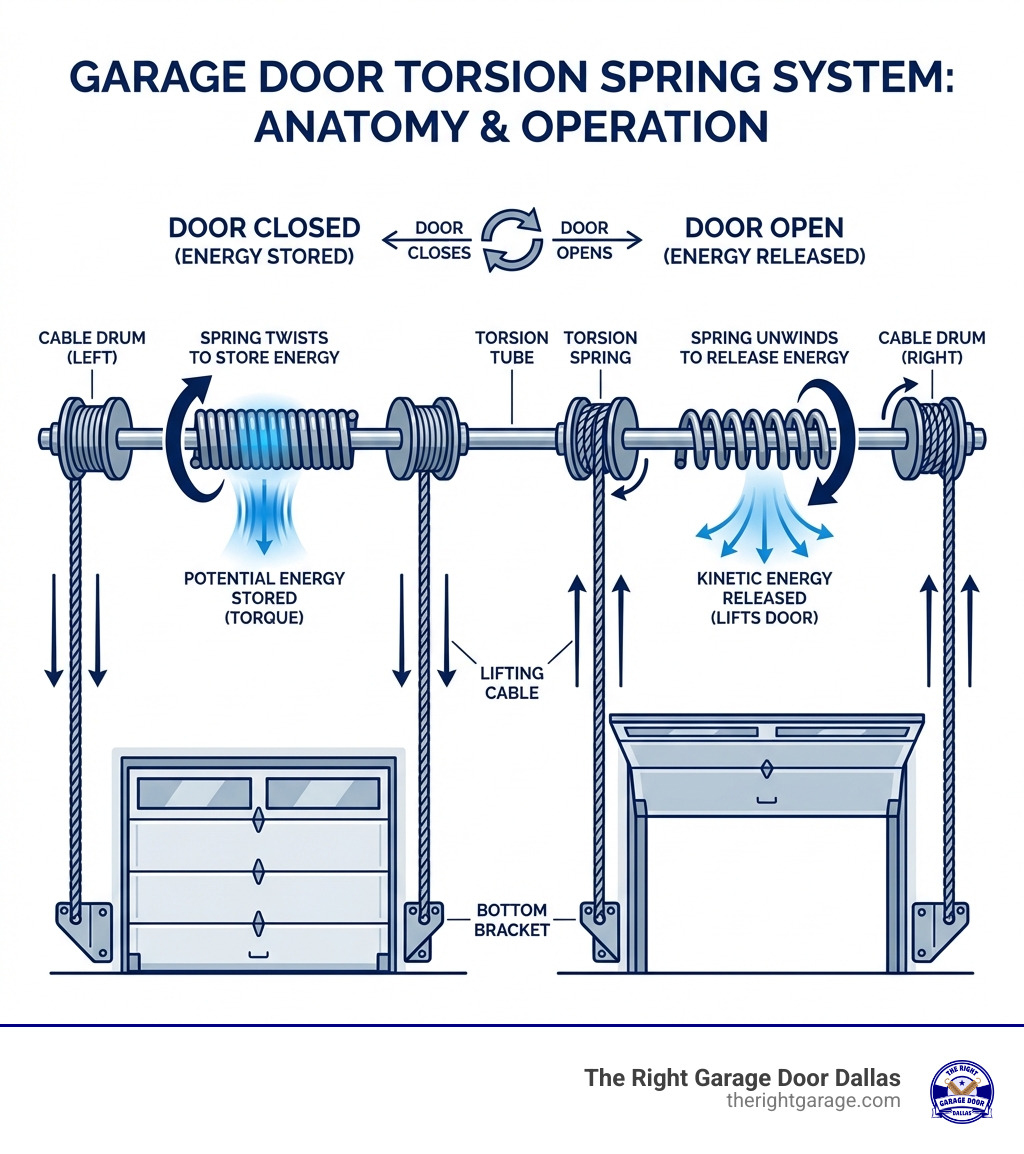
A garage door torsion spring is a tightly wound steel coil mounted horizontally on a metal shaft (torsion tube) above your door. Cable drums are on each end of the shaft, with lifting cables connecting them to the bottom of the door.
When the door is closed, the spring is under immense tension, storing mechanical energy. When you open the door, this stored energy is released as torque, rotating the shaft. This rotation winds the lifting cables around the drums, pulling the door upward. This precise counterbalance makes your heavy door move with ease.
The Mechanics of Counterbalance
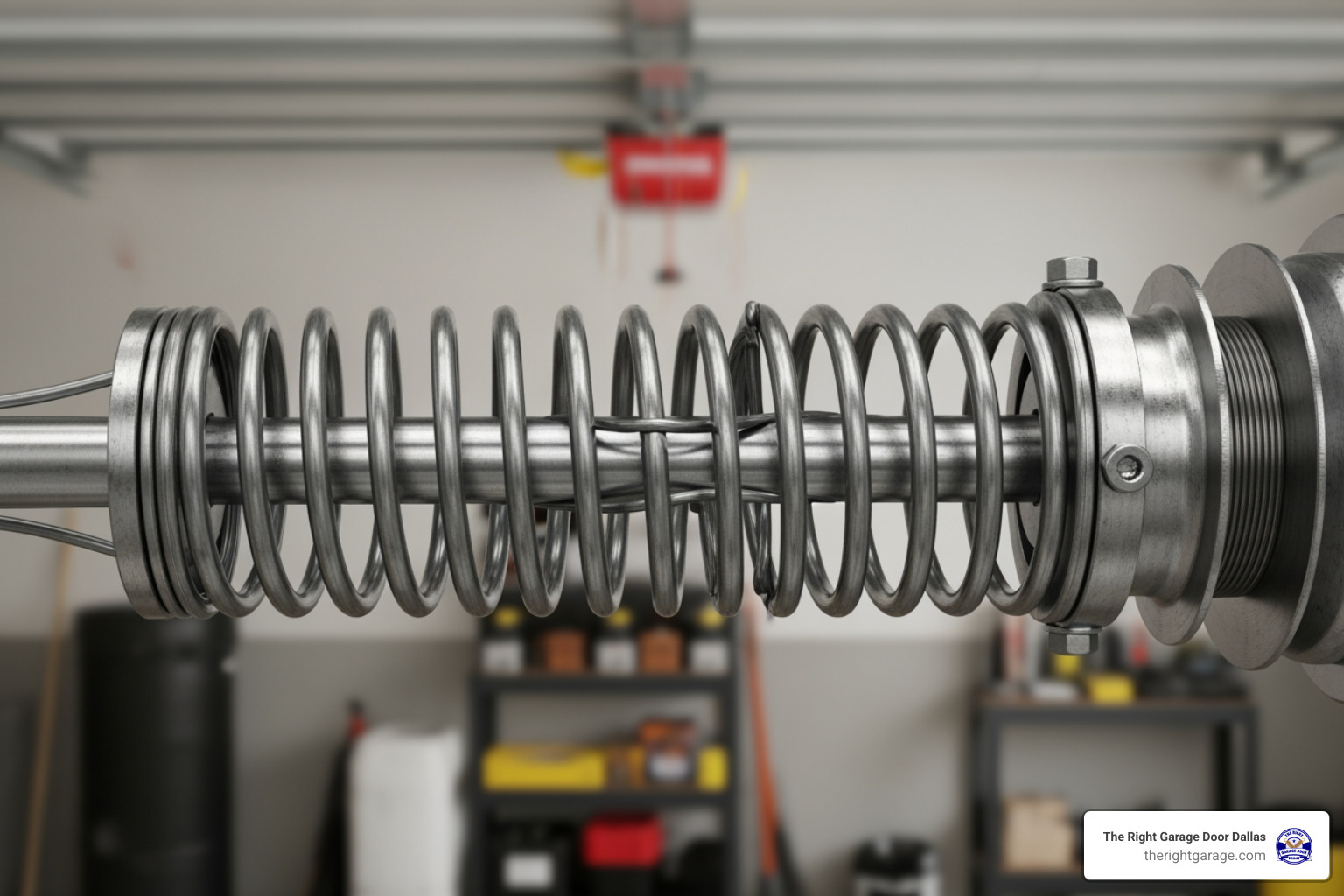
A garage door’s effortless movement comes from counterbalance. A balanced door feels nearly weightless when lifted manually because the force from the garage door torsion spring perfectly matches the door’s weight.
When the door is closed, the spring is fully wound. As it opens, the spring unwinds, releasing energy to lift the door. The door’s weight rewinds the spring when it closes, storing energy for the next cycle. This process offsets the door’s weight, making it easy to operate.
This precise counterbalance has several benefits:
- Effortless Lifting: Even a heavy, insulated garage door can be lifted with minimal effort, whether manually or with an opener.
- Reduced Opener Strain: Because the spring does the heavy lifting, your garage door opener only needs to manage the initial movement and control the speed, significantly reducing wear and tear on the opener’s motor and gears.
- Smooth Operation: The rotational force generated by torsion springs offers more control, resulting in smoother and quieter door movement with less vibration and noise compared to other spring types.
Single vs. Double Spring Systems
Your garage may have a single or double garage door torsion spring setup. While lighter, single-car doors can use one spring, we often recommend two for our Dallas-Fort Worth customers due to significant advantages.
Here’s why a dual-spring system is often preferred:
- Redundancy and Safety: If one spring breaks in a dual system, the other can still provide some support, preventing a sudden door collapse and allowing for safer operation until repairs can be made. This redundancy is a crucial safety benefit.
- Even Load Distribution: A dual-spring setup distributes the load more evenly, reducing stress on the entire system and extending the lifespan of all components.
- Extended Lifespan: Because each spring is doing less work individually, they tend to last longer. If one spring breaks, the other is likely to fail soon after, making it a good idea to replace both.
- Better for Heavy Doors: For heavier garage doors, such as insulated, custom wood, or full-view models common in the Dallas area, two springs are almost always necessary to provide adequate counterbalance and ensure safe, smooth operation.
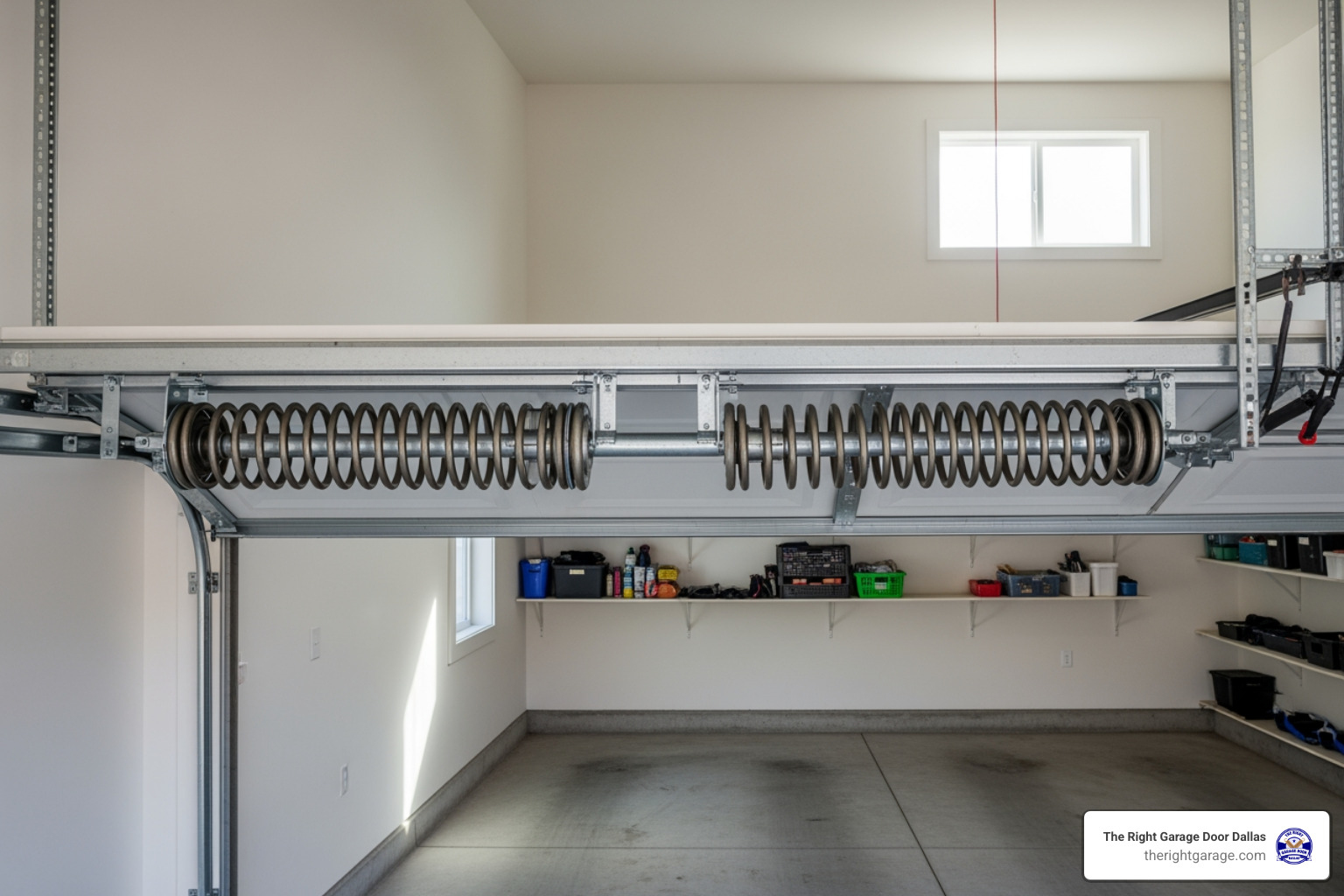
Converting a single spring system to a double, especially on a two-car garage, is possible and advisable. The process requires professional evaluation of your door’s weight, correct spring selection, and expert installation and balancing.
Torsion Springs vs. Extension Springs: A Detailed Comparison
Extension springs are another common type of garage door spring. While both torsion and extension springs counterbalance your door’s weight, they work differently, with significant implications for safety, durability, and performance. As your Dallas-Fort Worth experts, we’ll break down these differences.
| Feature | Torsion Springs | Extension Springs |
|---|---|---|
| Safety | Installed horizontally on a shaft, contained failure. | Installed vertically along tracks, uncontained failure (risk of flying parts without safety cables). |
| Lifespan | Generally longer (10,000+ cycles), more durable. | Generally shorter (5,000-10,000 cycles), less durable. |
| Cost | Higher initial cost, better long-term value. | Lower initial cost, potentially higher long-term replacement frequency. |
| Performance | Smoother, quieter, more controlled door movement, less vibration. | Can be jerkier, noisier, more vibration. |
| Ideal Use Case | Heavy doors, high usage, preference for safety and quiet operation, modern sectional doors. | Lighter doors, limited headroom, older or one-piece doors, budget-conscious. |
Mechanics and Configuration
The primary difference between a garage door torsion spring and an extension spring lies in their mechanics and configuration.
- Torsion Springs: Mounted horizontally on a tube above the door, these springs work by twisting. They store rotational energy as the door closes and release it as torque to lift the door. If a torsion spring breaks, the shaft contains most of the energy, making failure safer.
- Extension Springs: Mounted vertically along the tracks, these springs work by stretching. They store energy as the door closes and contract to pull it open. If an extension spring breaks, it can become a dangerous projectile. Safety cables, threaded through the springs, are essential to contain them during failure.
Durability, Lifespan, and Cost
When considering longevity, torsion springs generally offer a better investment.
- Durability and Lifespan: Torsion springs are more durable, rated for 10,000+ cycles (7-10 years of typical use), with high-cycle options available. Extension springs have a shorter lifespan, often 5,000-10,000 cycles, requiring more frequent replacement. A spring’s actual lifespan depends on correct sizing, installation, environment, and usage.
- Cost: Extension springs have a lower initial cost, but torsion springs are a better long-term investment due to their durability and longer lifespan. While torsion spring replacement is more complex and can have higher labor costs, fewer replacements over time often balance this out, saving you money and hassle.
Safety and Performance
For us, safety is paramount, and torsion springs generally come out ahead.
- Safety: Torsion springs are safer because when they break, the torsion tube contains the spring, preventing dangerous projectiles. Extension springs without safety cables can snap violently, causing injury or property damage in your Dallas garage.
- Performance: Torsion springs provide smoother, quieter, and more controlled movement with less vibration. The rotational force offers a more precise counterbalance. Extension springs can cause jerkier, noisier operation.
For heavy garage doors, including many of the insulated or custom doors we install in Plano, Frisco, or Richardson, torsion springs are ideal. They handle substantial loads more effectively than extension springs. The market is also shifting towards torsion spring systems, meaning parts for extension spring systems may become less available over time.
Maintenance and Replacement for Your Garage Door Torsion Spring
Even the best garage door torsion spring has a limited lifespan. Regular maintenance and timely replacement are crucial for safety and function. As your trusted garage door experts in Dallas-Fort Worth, we’re here to guide you.
Key Signs Your Garage Door Torsion Spring is Broken
A broken garage door torsion spring is usually unmistakable. Here are the key signs that indicate your spring needs immediate attention:
- Loud Bang or Pop: This is often the most dramatic and common sign. When a torsion spring breaks, it releases a tremendous amount of stored energy, creating a sound that can be as loud as a gunshot.
- Visible Gap in the Spring: After hearing the bang, you’ll likely see a clear separation or gap in the coil of the spring mounted above your door.
- Crooked or Uneven Door: A broken spring often causes the door to sit crookedly in its tracks or become uneven when attempting to open it.
- Door Slams Shut: If your garage door opens slightly and then suddenly slams shut, it’s a strong indicator that the spring has failed.
- Opener Strains or Fails to Lift: Your garage door opener will struggle immensely, or simply fail, to lift the door. It might hum loudly as it tries to pull a suddenly heavy door.
- Door Feels Extremely Heavy: If you try to lift the door manually (after disengaging the opener), it will feel incredibly heavy.
If you notice any of these signs, it’s critical to stop using your garage door immediately and contact us for professional repair.
The Dangers of DIY Repair
We cannot stress this enough: replacing a garage door torsion spring is extremely dangerous and should never be attempted by an untrained individual. The springs are under immense tension, storing enough energy to cause:
- Serious Injury Risk: The spring can snap violently, winding bars can slip, or the entire assembly can come loose, leading to severe lacerations, broken bones, or even fatal injuries.
- Property Damage: An uncontrolled spring release can damage your garage door, your vehicle, or other property in your garage.
- Increased Repair Costs: An improper DIY repair can lead to further damage to your garage door system, ultimately costing you more in professional repairs.
Our licensed technicians in Dallas, Fort Worth, and surrounding areas have the specialized tools, training, and experience to safely and effectively replace your springs. Learn about our professional repair services and let us handle this hazardous task for you.
Upgrading from Extension to Torsion Springs
If your garage has extension springs, upgrading to a garage door torsion spring system is highly beneficial, especially for sectional doors. We regularly perform these conversions for homeowners in Frisco, Plano, and other North Texas communities because the advantages are compelling:
- Improved Safety: Torsion springs are inherently safer due to their contained operation.
- Improved Durability: Torsion springs are generally more robust and have a longer lifespan.
- Smoother Operation: You’ll experience a noticeable difference in how smoothly and quietly your door operates.
- Better for Heavy Doors: Torsion springs are far more effective at counterbalancing the weight of an insulated or heavier door.
- Better Parts Availability: The market is shifting towards torsion spring systems, so parts may be more readily available.
The conversion process involves removing the old extension spring system and installing a new torsion spring assembly. This is a complex job that requires precise measurements and expert installation to ensure proper balance and safe operation. If you’re considering an upgrade, don’t hesitate to reach out. Get a Free Quote from us for a system upgrade that improves your garage door’s safety and performance.
Best Practices for Selecting the Correct Torsion Spring
Selecting the correct garage door torsion spring is crucial for the safe and efficient operation of your garage door. An improperly sized spring can lead to premature wear on your opener, a door that’s difficult to open, or even a dangerous situation.
How to Measure a Garage Door Torsion Spring
Accurately measuring your existing torsion spring is the critical first step in finding a replacement. Since wire sizes can be mixed, it’s imperative to measure both springs if two are present. Here are the key measurements you’ll need:
- Wire Size: This is the wire’s diameter. The best method is to measure the length of 10 or 20 compressed coils and divide. For example, if 20 coils measure 4 inches, the wire size is 0.200 inches (4 divided by 20). Using calipers can be inaccurate due to coil curvature, corrosion, or paint.
- Inside Diameter (ID): This is the measurement of the inside of the spring coil. Look for markings on the winding and stationary cones (the metal pieces at the ends of the spring). If no markings are found, you can use calipers or a ruler to measure the inside of the spring to the nearest 1/16th of an inch. Common residential IDs are 1.75 inches and 2 inches.
- Spring Length: Measure the length of the spring from one end of the coil to the other, excluding the cones. If the spring is broken, slide the two pieces together to measure. A wound spring is shorter than its unwound length; a professional can best estimate the unwound measurement if needed.
- Wind Direction (Left vs. Right): This refers to the direction the coils are wound. A right-wind spring’s end points up and to the right (clockwise coils). A left-wind spring’s end points up and to the left (counter-clockwise coils). Residential doors typically have one of each.
For a detailed visual guide, you can check online resources like How to Measure Garage Door Torsion Springs. However, for absolute accuracy and safety, we recommend letting a professional handle these measurements.
Understanding Common Specifications
With the correct measurements, we can select the perfect replacement garage door torsion spring for your door.
- Wire Size and Door Weight: The wire size is directly related to the weight of your garage door. Heavier doors require thicker wire sizes to generate the necessary torque. For example, a regular non-insulated door might use a .207 wire size, while a heavier insulated or wood door could require a .243 or .250 wire size.
- Standard vs. High-Cycle Options: While most springs are rated for 10,000 cycles, you can opt for high-cycle springs (e.g., 20,000 or 30,000 cycles) for improved durability, especially if your garage door sees frequent use.
- Manufacturer Specifications: We always recommend adhering to the manufacturer’s specifications for replacement springs. Our team can help cross-reference these details, ensuring the replacement spring generates an equal torque output to maintain the proper balance for your door.
When choosing a spring, it’s not just about finding a spring, it’s about finding the right spring. This is where our expertise at The Right Garage Door Dallas comes in handy.
Frequently Asked Questions about Torsion Springs
We frequently get questions about garage door torsion springs from our clients across Dallas, Fort Worth, Plano, and beyond. Here are some of the most common ones we hear:
How long do garage door torsion springs last?
A standard garage door torsion spring is rated for about 10,000 cycles (one open and close). For the average homeowner using their door 3-4 times a day, this translates to a lifespan of roughly 7-10 years.
However, several factors can affect how long your springs actually last:
- Usage Frequency: If you use your garage door more often, your springs will wear out faster.
- Maintenance: Regular lubrication and professional inspections can help extend spring life.
- Climate: The extreme temperatures and humidity in North Texas can impact metal components over time.
- Correct Sizing: An improperly sized spring will be overworked, leading to premature failure.
Can I open my garage door if the torsion spring is broken?
No, we strongly advise against attempting to open your garage door if the garage door torsion spring is broken. Here’s why:
- Extreme Weight: Without the spring’s counterbalance, your door becomes incredibly heavy, weighing hundreds of pounds. Trying to lift it manually can cause serious back injuries.
- Damage to the Opener: Your opener is designed to guide the door, not lift its full weight. Using it with a broken spring will put immense strain on the motor and gears, likely causing irreversible damage.
- Safety Hazard: An unbalanced door can come crashing down unexpectedly, posing a significant risk.
If your torsion spring is broken, the safest course of action is to keep the door closed and call a professional garage door service like The Right Garage Door Dallas immediately.
Is it better to replace one or both springs at the same time?
If one spring in a dual-spring system breaks, we almost always recommend replacing both at the same time for several reasons:
- Matching Wear and Tear: Springs are installed at the same time and undergo the same number of cycles. If one has broken, the other is likely near the end of its lifespan.
- Preventing a Second Failure: Replacing both at once prevents you from having another spring break soon after, saving you the inconvenience and cost of another service call.
- Saving on Labor Costs: You’ll only pay for one service visit and one labor charge to replace both springs, which is more cost-effective than two separate visits.
- Ensuring a Balanced System: Installing two new springs ensures your garage door system is perfectly balanced, promoting smoother operation and extending the life of all components.
While it might seem like an extra expense upfront, replacing both springs provides peace of mind and saves money in the long run.
Conclusion
The garage door torsion spring may be an “unsung hero,” but its role in the daily function, safety, and longevity of your garage door system is absolutely critical. We hope this guide has shed light on how these powerful components work, how they differ from extension springs, and why their proper maintenance and timely replacement are so important.
From understanding the mechanics of counterbalance to recognizing the tell-tale signs of a broken spring, prioritizing professional service for repairs is a decision that protects your family, your property, and your investment. The high tension and stored energy in these springs make DIY repairs incredibly hazardous, and we strongly advocate for leaving this work to the experts.
At The Right Garage Door Dallas, we pride ourselves on offering expert residential and commercial garage door repair, installation, and maintenance across the Dallas-Fort Worth area, including Plano, Frisco, Richardson, Irving, Carrollton, and Garland. Our licensed technicians provide fast, local, same-day service, 24/7 emergency support, and upfront pricing. For safe and reliable garage door operation, trust our expert technicians for all your spring repair and replacement needs. Explore our garage door services today and let us keep your garage door’s powerhouse running smoothly.


